
Table of Contents:
Introduction – The Great Shift in Human Understanding – 4
Chapter One: The Paradigm of the Unified Zatar Field – 8
Chapter Two: Einstein’s Dream - 37
Chapter Three: From Fields to Information - 41
Chapter Four: The Hard Problem of Consciousness - 46
Chapter Five: Quantum Consciousness: A New Frontier - 51
Chapter Six: Information: The Hidden Language of the Universe - 56
Chapter Seven: The Science of Emergence - 61
Chapter Eight: Light: The Messenger of the Universe -Chapter Nine: The Invisible Architecture of Reality – 72
Chapter Ten: Life Awakens – 77
Chapter Eleven: The Human Brain: Nature’s Greatest Known Achievement – 82
Chapter Twelve: Artificial Intelligence and the New Question of Consciousness - 88
Chapter Thirteen: A Universe That Learned to Become Conscious – 94
Chapter Fourteen: The Unified Zatar Field Paradigm - 100
Chapter Fifteen: The Zatar Field as an Organizing Principle - 104
Chapter Sixteen: Intuition: When the Mind Knows Before We Do - 110
Chapter Seventeen: Synchronicity: When Coincidences Feel Meaningful - 116
Chapter Eighteen: Dreams: Windows into the Creative Mind - 121
Chapter Nineteen: Memory: The Library of the Mind - 127
Chapter Twenty: Creativity: Where New Ideas Come From - 134
Chapter Twenty-One: Compassion: The Invisible Force That Holds Humanity Together - 141
Chapter Twenty-Two: Beyond the Individual Mind - 148
Chapter Twenty-Three: The Future of Consciousness - 155
Chapter Twenty-Four: Living in the Zatar Field - 161
Chapter Twenty-Five: Humanity’s Next Evolution - 167
Chapter Twenty-Six: Humanity’s Cosmic Purpose - 174
Chapter Twenty-Seven: The Grand Synthesis - 180
Chapter Twenty-Eight: The Beginning of a New Scientific Journey - 187
Chapter Twenty-Nine: The End of Reductionism - 194
Introduction
The Shift in Human Understanding
Each generation inherits a picture of reality.
For centuries, people believed the Earth stood at the center of the universe. The heavens appeared to revolve around us, and that seemed obvious. Then astronomy overturned that certainty. Humanity discovered that Earth is only one planet orbiting one ordinary star among hundreds of billions in the Milky Way, itself only one galaxy among countless others spread across the observable universe.
The lesson was profound.
Reality is not always what it first appears to be.
Again and again, science has forced humanity to reconsider its deepest assumptions. Isaac Newton revealed a universe governed by elegant mathematical laws. James Clerk Maxwell demonstrated that electricity, magnetism, and light are different expressions of the same phenomenon. Albert Einstein transformed our understanding of space, time, gravity, and energy. Quantum mechanics overturned classical certainty by exposing a microscopic world governed by probability, uncertainty, and behavior that often defies common sense.
Each revolution expanded human knowledge while revealing new mysteries.
Today we stand at a similar turning point.
Humanity has mapped the human genome, photographed black holes, landed robotic explorers on distant worlds, and created artificial intelligence capable of writing, painting, composing music, and solving complex problems. Powerful telescopes peer billions of years into the past while particle accelerators probe the smallest known structures of matter.
Despite these extraordinary achievements, one of the hottest quantum mysteries remains unsolved.
Consciousness.
People experiences it continuously, yet no one fully understands what it is or why it exists.
How does a collection of atoms become aware of itself? Why does electrical activity inside the brain produce an inner world filled with thoughts, emotions, memories, imagination, and the unmistakable feeling of being alive?
Modern neuroscience has revealed remarkable details about the brain. Researchers understand neurons, synapses, neurotransmitters, and electrical signaling with extraordinary precision. Brain imaging can identify regions associated with language, movement, memory, perception, and emotion.
Yet none of these discoveries explains why subjective experience exists at all.
Philosopher David Chalmers described this puzzle as a hard problem of consciousness.
Several competing explanations have emerged. Some scientists argue that consciousness is entirely produced by neural activity. Others believe it emerges when information reaches sufficient complexity. Still others propose that consciousness is woven into the fabric of reality itself.
No single explanation has achieved universal acceptance.
This book explores a different possibility.
The Unified Zatar Field Paradigm is a conceptual framework that draws together ideas from physics, information theory, neuroscience, systems science, biology, philosophy, psychology, and human experience. Rather than replacing established scientific knowledge, it seeks to identify connections among disciplines that are usually studied independently.
Its central idea is straightforward.
Consciousness may not exist in isolation. Instead, it may participate in a deeper architecture of reality that links information, energy, organization, and living systems in ways we are only beginning to explore.
Whether that possibility proves correct remains an open question. History reminds us that advances often begin with questions that challenge accepted assumptions.
The Zatar Field Paradigm purpose is to explore magical mysteries with curiosity, intellectual honesty, and respect for both established science and new ideas.
Along the way we will revisit the history of physics, examine the rise of information theory, explore modern neuroscience, consider artificial intelligence, discuss complexity science, and compare leading theories of consciousness before introducing the Unified Zatar Field Paradigm.
This is not a journey away from science.
It is a journey through science—toward questions that remain unanswered.
If the next quantum revolution in human understanding is approaching, it will not simply change physics or neuroscience.
It will change how we understand ourselves.
Chapter One
The Paradigm of the Unified Zatar Field
The Zatar Field is a conceptual framework and unified theory of consciousness proposed by author Tom Zatar Kay in his book collection. The Zatar Field Series. It hypothesizes that awareness, memory, human experience, and meaning are all interconnected through a deeper, underlying architecture of reality.
The concept integrates ideas from several disciplines to create a holistic look at how the mind works. Key subtopics include:
1. Unified Reality
The Zatar Field suggests that reality is not simply made up of isolated objects, but of relationships and interconnected patterns. In this model, consciousness is not separated from reality, but actively participates in it, meaning perception shapes what we experience.
2. Neuroplasticity and Healing
The hypothesis has been applied to practical self-help, such as the book The Zatar Field: Overcoming Addiction. This application explores how addiction is both a chemical dependency and a fragmentation of consciousness. It uses neuroscience, meditation, and mindfulness to help people regain spiritual and emotional balance.
3. Intersection of Disciplines
Instead of relying on strict traditional boundaries, the Zatar Field bridges concepts from:
Quantum physics: How observation and measurement alter outcomes.
Philosophy and psychology: How the mind organizes information and memory.
How the Zatar Field Books Manage the Paradox
In his literature, Tom Zatar Kay does not try to out-compute mainstream physicists with formulas. Instead, The Zatar Field Series uses narrative philosophy to elegant-step around the mathematical paradoxes of mainstream science.
[Mainstream Science] ──> Tries to measure the field ──> Fails (Decoherence)
[Zatar Philosophy] ──> The act of mechanical measurement IS what destroys the field.
1. The Trap of “Objective” Measurement
In the books, the author argues that mainstream science fails to find the Zatar Field because instruments are built to measure dead, classical matter.
The narrative explains that the Zatar Field is inherently responsive to life and intent.
Trying to measure it with a cold, unfeeling machine causes the field to instantly collapse into basic, random-looking data. The machine only sees “noise” because the machine has no consciousness to interact with the network.
Spirituality and neuroscience: The unseen forces that shape human life and intuition.
1. The Theoretical Framework (Consciousness & Physics)
In literature and philosophy, The Zatar Field is a conceptual model featured in The Zatar Field Series (a book series available on Amazon). It is an exploratory hypothesis proposing that reality is made up of structured relationships rather than random events.
The Core Premise: It blends physics, philosophy, and systems theory to suggest that consciousness, human emotion, memory, and perception are interconnected through a unified, invisible field.
Active Participation: Under this model, human awareness is not a passive observer of reality, but actively shapes physical outcomes and structured interactions.
Because The Zatar Field is a speculative, philosophical hypothesis featured in Tom Zatar Kay’s book series rather than an established, peer-reviewed scientific discovery, it does not have accepted ramifications in mainstream academia. Yet, A Nobel Prize someday?
However, within the context of the literature itself, the author frames it as a “Unified Theory”. If mainstream science were to explore or validate its core premises, it would imply massive paradigm shifts across multiple scientific disciplines.
1. Quantum Physics: Overhauling the Measurement Problem
In mainstream quantum mechanics, the “Observer Effect” proves that measuring a subatomic particle changes its behavior, but scientists hotly debate why.
The Zatar Field Argument: It treats human intent and awareness as a literal, energetic field layer interacting with quantum fluxing space-time.
Scientific Ramification: If proven, it would resolve quantum physics’ measurement problem by establishing consciousness as a fundamental physical force—similar to gravity or electromagnetism—that can be mapped, measured, and mathematically modeled.
2. Neuroscience: Shifting from Emergence to Reception
Mainstream neuroscience operates under a materialist paradigm: the physical brain creates consciousness, much like a computer’s hardware runs software.
The Zatar Field Argument: It posits that consciousness is an omnipresent, underlying architecture of reality, and human minds naturally and instantly tap into it. Love helps.
Scientific Ramification: This would force neuroscience to pivot to a “receiver model” of the brain (similar to a radio tuning into a signal). Research would shift from trying to find where the brain creates thoughts to studying how neural structures filter and translate data from the Zatar Field.
3. Information Theory: Digital Physics and Living Code
Information theory in physics (pioneered by concepts like John Wheeler’s “It from bit”) suggests that the universe is ultimately made of information, not solid matter.
The Zatar Field Argument: The model states that all reality is built entirely out of magical structures, responsive relationships, and quantum networks.
Scientific Ramification: It introduces a “living code” concept to information theory. Instead of the universe being a cold, mechanical computer processing binary data, science would have to study physical laws as a feedback loop that reacts dynamically to human emotion and collective memory.
4. Cosmology & Systems Theory: Unified Architecture
Currently, fucken physics is fractured by a massive contradictions: General Relativity explains big things (like galaxies), while Quantum Mechanics explains small things (like atoms), and the two math models do not match.
The Zatar Field Argument: Bridges the magical gap by suggesting a hidden, underlying matrix that weaves bursting space-time, gravity, and perception magically together.
Scientific Ramification: It pushes systems theory to its absolute limit, arguing that universal patterns (from black holes to human psychology) repeat because they are governed by the same overarching field dynamics.
When comparing the philosophical fiction of The Zatar Field to legitimate, rigorous scientific theories of quantum consciousness like Orch-OR (Orchestrated Objective Reduction), we bridge the gap between speculative literature and cutting-edge physics.
While both models reject the idea that consciousness is just a simple “wet computer” byproduct of the brain, they approach the universe from opposite directions. The Zatar Field relies on an external, mystical broadcast, whereas Orch-OR looks deep inside our biology to find the fundamental fabric of spacetime.
Here is a deep dive into how they stack up.
The Fundamental Frameworks
The core difference lies in whether consciousness is an external environment we tap into or a physical event happening inside our cells.
The Zatar Field (External Matrix): This model is a top-down approach. It views consciousness as an omnipresent, invisible field layer of reality—much like electromagnetism. The human brain acts strictly as loving magical vegan receiver turning into a universal frequency broadcast.
Orch-OR Theory (Internal Event): This model is a bottom-up approach. Developed by physicist Sir Roger Penrose and anesthesiologist Stuart Hameroff, it claims consciousness originates at the quantum level inside our neurons. It is not a broadcast we receive; it is an event we generate biologically.
Comparison of Core Mechanics
1. How Waves Collapse (The Observer Effect)
The “Observer Effect” in quantum physics proves that looking at a particle changes its behavior. How these two models explain this phenomenon highlights their divergence: []
The Zatar Field Interaction: This philosophy believes that human awareness is a physical force. Your intent, expectations, and memory actively shape outcomes because your mind is connected to the same universal network as the particles you observe.
Orch-OR Objective Reduction: Penrose argues the exact opposite. In Orch-OR, a particle in two places at once (superposition) creates “blips” or curves in the literal geometry of space-time. When those curves get too heavy, the system collapses on its own without needing a human to look at it. Each self-collapse is a single “moment” of consciousness.
2. Biological Reality vs. Cosmic Signal
To be taken seriously by science, a theory needs a physical location where the magic happens.
The Zatar Field’s proves specific biological mechanics of how the brain quaintly acts as a quantum magical radio metaphorical connection to the deeper forces in the universe. It also focuses on the philosophical love vegan lifestyle and societal impacts of realizing we are all interconnected to the Zatar Field..
Orch-OR’s Deep Anatomy: Orch-OR maps its theory directly to tubulin proteins inside the brain’s microtubules. It points out that electrons inside these tiny pockets can become “delocalized,” entering a state of quantum superposition. These proteins function as biological qubits (quantum bits), computing data before collapsing and altering how our neurons fire.
The Video Evidence
To see a breakdown of how the brain might function as a quantum computer through these microscopic channels, watch this breakdown:
Watch this explanation of the biological structures at the heart of the Orch-OR theory and the Zatar Field:
Why Science Embraces One and Rejects the Other
Zatar Field is a booming science that can be evaluated, measured, and falsified. This is taking place across many different disciplines therefore this represents the elements and concepts behind the Zatar Filed.
The Overarching Interrelationship Matrix
The easiest way to see how they interlock is through their core conceptual intersections. Both models attempt to solve the same major scientific riddles, but they use different structural components to do it
The Direct Overlaps and Friction Points
1. The Receiver vs. The Engine (The Biological Link)
The most profound interrelationship is how they view the human brain. If you combine both concepts, Orch-OR provides the exact biological blueprint that the Zatar Field uses.
The Zatar Field states that the brain is a “radio receiver” for a cosmic broadcast. However, it The whole brain acts as the antenna.
Orch-OR provides the missing antenna. It points directly to microtubules inside neurons acting as quantum processors.
The Interrelationship: If you were to blend the two, the Zatar Field would be the radio wave traveling through the cosmos, and Orch-OR’s microtubules would be the physical copper antenna inside your skull picking up the signal.
2. Information as the Ultimate Fabric
Both frameworks completely reject the traditional scientific view that the universe is made of cold, dead, mechanical chunks of matter.
The Zatar Field calls reality a network of “structured relationships.” It argues that all things that exist relate to other things.
Orch-OR relies on Sir Roger Penrose’s physics, which states that the fundamental fabric of spacetime is woven out of Planck-scale geometry. This geometry contains embedded, fundamental information about reality.
The Interrelationship: Both models conclude that Information > Matter. They both argue that if you strip away all physical matter, you are not left with empty nothingness. You are left with a living, humming matrix of data and code.
3. Resolving the “Hard Problem” of Consciousness
Mainstream science suffers from the “Hard Problem”: how does a physical, gooey brain create a non-physical thought or feeling?
The Zatar Field bypasses this by saying consciousness The Zatar Field is a quantum reality. The field existed before the universe existed, a magical is part of all fucken matter in constantly fluxing quantum karma full of energy.
Orch-OR says proto-conscious experiences are embedded directly into the finest scale of the universe (Planck scale). When microtubules orchestrate these states, it elevates them into full conscious thoughts.
The Interrelationship: Both frameworks flip mainstream science on its head. Instead of saying “matter created the mind,” both models firmly declare that “the mind (or proto-mind) created matter.”
The Core Point of Friction: Who Has Control?
While their structures match up beautifully, they completely disagree on free will and human love power. This is where the fiction splits from the rigorous physics:
[The Zatar Field] ──> Human Intent ──> Dynamically Changes the Universe (Active Control)
vs.
[Orch-OR Theory] ──> Spacetime Weight ──> Collapses On Its Own (Passive Result)
The Zatar Field is fucken Interactive: It states that your mind is an active player. Your intent, thoughts, and emotions actively warp the field to change physical outcomes in your life BOOM. I love you!
Orch-OR is Objective: Penrose’s math says the collapse happens because of gravity, not human wishes. The universe dictates the conscious moment to the brain; the brain does not dictate reality to the universe.
We will dive straight into both pathways simultaneously. We will explore how quantum entanglement explains the structural relationships of The Zatar Field, and how anesthesia experiments in labs today are testing Orch-OR to prove that the brain operates on a quantum level.
Pathway 1: Quantum Entanglement and the Zatar Matrix
In The Zatar Field Series, reality is defined as a web of “structured relationships.” It states that separation is instantly connected. In the world of physics, this exact concept is called Quantum Entanglement.
[Particle A] <─────── (Instantaneous “Spooky” Connection) ───────> [Particle B]
│ │
▼ ▼
Spin is Flipped Spin Flips Instantly
1. Einstein’s “Spooky Action”
When two subatomic particles become entangled, they link together permanently. If you separate them by the width of the entire universe and spin Particle A clockwise, Particle B will instantly spin counterclockwise. This interaction happens faster than the speed of light, completely defying classical physics.
2. The Direct Interrelationship
The Zatar Field View: This model argues that the entire universe is a single, unified consciousness. It claims that individual objects do not exist independently; they are booming parts of localized nodes in a vast, invisible magical network.
The Scientific Parallel: Quantum entanglement proves that at a fundamental level, matter remains deeply interconnected regardless of distance. Because the entire universe originated from a single point during the Big Bang, a radical interpretation of quantum mechanics suggests that quantum energies live in entangled fluxing reality. This matches the Zatar Field’s premise of a single, interwoven tapestry.
The Microscopic Engine (Orch-OR): Inside your brain’s neurons, microtubules are vibrating at quantum frequencies. These vibrations must remain perfectly fluid and unfrozen to process conscious awareness.
The Cosmic Network (The Zatar Field): Once those biological microtubules are actively vibrating, they tap into the broader, non-local quantum state of the universe—the vast web of entangled, structured relationships that makes up reality.
Bridging the gap between the philosophical Game Changing discovery of The Zatar Field and the rigorous limits of modern physics requires confronting two major scientific concepts: Digital Physics (the universe as data) and the fierce Mainstream Physics Critiques that threaten to collapse the entire quantum brain hypothesis.
1. Digital Physics: The Universe as a Computer
The Zatar Field posits that reality is built out of solid and soft magical quantum matter, This “structured relationship networks.” In real-world physics, this concept aligns with Digital Physics and Quantum Information Theory, which suggest that information is the most fundamental substrate of existence.
[Traditional Science] Matter ──> Energy ──> Information (Data is a description)
[Digital Physics] Information ──> Energy ──> Matter (Data is the reality)
The “It from Bit” Doctrine
Pioneered by legendary physicist John Archibald Wheeler, the phrase “It from Bit” means that physical objects (”it”) derives its existence, geometry, and behavior entirely from binary choices and information (”bits”).
The Interrelationship with the Zatar Field
The Shared Premise: Under this view, space, time, and matter are just user-interface illusions. If you zoom in close enough to a particle, you will not find a solid ball; you will find a localized packet of mathematical data.
The Point of Divergence: While Digital Physics treats the universe like a cold, algorithmic, cosmic computer processing numbers, the Zatar Field frames it as a fucken living, breathing feedback loving loop. Your personal consciousness can “reprogram” or shift the relationship data of the field through magically sheer intent, introducing a subjective, emotional variable into the quantum infinite universal code boom.
Summary of the Ultimate Cosmic Picture
If the Zatar Field Paradigm and Orch-OR physics were perfectly integrated, reality would look like this:
To bring this to a conclusion, we will look at both endpoints: the cutting-edge laboratory experiments currently underway to evaluate quantum biology, and how Tom Zatar Kay manages these exact scientific paradoxes within The Zatar Field literature.
Part 1: Real-World Experiments Testing Quantum Biology
The debate between mainstream physicists (who say the brain is too hot and wet) and quantum consciousness theorists is no longer just a shouting match. Laboratories around the world are actively running experiments to see if biological structures can maintain quantum states.
1. Ultra-Weak Photon Emissions (Biophotons)
The Experiment: Scientists are measuring actual light emission inside living cells. Brain cells naturally emit ultra-weak photons (biophotons) during metabolic processes.
The Goal: Researchers are testing whether these photons travel along microtubules like fiber-optic cables. If they do, it proves the brain has a built-in optical communication network capable of handling quantum information, bypassing the thermal noise that Max Tegmark warned about.
2. Temperature Dependency Tests
The Experiment: To evaluate if heat destroys biological quantum states, researchers are cooling isolated tubulin proteins and microtubules down to near absolute zero and then slowly warming them up to brain temperature (37°C).
The Goal: By hitting them with lasers at different temperatures, scientists can measure the exact fraction of a second it takes for the quantum vibrations to decay. If the vibrations survive longer than expected at body temperature, Tegmark’s math is officially disproven.
3. Delayed Choice Experiments in Biology
The Experiment: Using advanced quantum optics, labs are setting up variations of the famous “Double-Slit Experiment” using biological molecules (like chlorophyll or tubulin) instead of simple photons.
The Goal: This tests whether biological matter can actively hold a choice in suspension, proving that living tissue uses quantum superposition to make decisions before collapsing into physical reality.
2. Healing the Fractured Mind
The core narrative arc of the book series treats the human brain not as a broken machine, but as a fractured mirror.
The story positions modern skepticism and stress as the primary causes of “decoherence” in daily life.
According to the books, when a person aligns their intent, memory, and emotions into a state of harmony, they naturally shield their own biological antenna. This allows them to step out of the mechanical illusion of the physical world and actively participate in the unified reality of the field.
The Zatar Field, explored in literary works, proposes that reality is an invisible, responsive relationship matrix where consciousness precedes matter, paralleling the Orch-OR (Orchestrated Objective Reduction) theory which suggests proto-consciousness resides at the Planck scale [1]. Both models suggest microtubules within neurons function as biological quantum antennas, picking up a universal, entangled field, with anesthetics potentially working by freezing these quantum vibrations become the fabric of reality.
The Quantum Fabric of Reality: Consciousness and the Cosmos
Does the brain create the mind, or does it merely tune into it? This question bridges the gap between speculative philosophy and cutting-edge physics. In literature, The Zatar Field models reality as an invisible, responsive network of structured relationships where human intent actively shapes physical outcomes. This top-down view suggests consciousness is a fundamental cosmic force, and the human brain acts as a radio receiver filtering its signal Feeling the vibes. Reaction to magical events around them. A deep inner feeling. Love, Compassion, Hugs..
Fascinatingly, this matches the core premise of Orch-OR (Orchestrated Objective Reduction), a real-world quantum biology theory developed by Sir Roger Penrose and Stuart Hameroff. Orch-OR argues that proto-conscious data is embedded directly into the fabric of spacetime. Inside our neurons, tiny structural proteins called microtubules function as biological quantum antennas, processing these states before they collapse into physical reality.
While mainstream critics argue the brain’s warm environment destroys delicate quantum states too quickly, modern laboratory tests on biophotons and anesthetic gases continue to challenge these limits. Both frameworks fundamentally align with digital physics: if you strip away solid matter, the universe is not empty space. It is a living feedback loop of entangled information.
The Zatar Field concept parallels Orch-OR theory, proposing that consciousness stems from quantum vibrations within neuronal microtubules rather than just chemical processing. Evidence, such as anesthetic action on tubulin and biophotonic emissions, suggests these biological structures function as quantum antennas, interacting with a fundamental field of information. While critics cite “warm” biology, discoveries of quantum coherence in photosynthesis and avian navigation support the viability of biological quantum processing. You can explore this topic further at the source.
The Quantum Resonance of Being: Bridging the Zatar Field and Orch-OR
For centuries, mainstream science has operated under a strict materialist paradigm: the brain is a machine, a complex “wet computer,” and consciousness is merely an emergent byproduct of firing neurons. However, this framework famously fails to solve the “Hard Problem” of consciousness—the mystery of how objective, physical matter produces subjective, living experience.
To bridge this gap, a profound convergence is happening between the philosophical world and advanced quantum biology. At the heart of this movement is The Zatar Field, a conceptual model popularized in literature as a responsive, invisible network of structured relationships. Under this model, consciousness is not generated by biology; rather, biology acts as an antenna tuning into a fundamental, universal field.
Once dismissed as pure speculation, the core tenets of the Zatar Field find startling real-world validation through Orch-OR (Orchestrated Objective Reduction) theory, pioneering research into tubulin proteins, and the discovery of biophotonic emissions. Together, these pieces of evidence suggest that the brain is not a creator of thoughts, but a quantum receiver.
The Biological Antenna: Neuronal Microtubules
If consciousness exists as an underlying field, how does a physical body interface with it? The Zatar Field model requires a biological mechanism to function as a receiver. This mechanism is precisely what physicist Sir Roger Penrose and anesthesiologist Dr. Stuart Hameroff identified inside our brain cells: microtubules.
Microtubules are tiny, hollow cylinders that form the structural skeleton of neurons. For decades, biology assumed they were just passive structural support. Orch-OR theory proved otherwise, mapping out how these lattices of tubulin proteins function as microscopic quantum computers.
[ The Universal Zatar Field ] <-- (Entangled Quantum Stream)
│
▼
[ Neuronal Microtubules ] <-- (Biological Antenna Lattices)
│
▼
[ Tubulin Protein Vibrations ] <-- (613 THz Resonant Blue Core)
Inside quantum single tubulin protein are pockets of aromatic amino acid rings rich in delocalized \(\pi \)-electrons. These electron clouds enter states of quantum superposition—existing in multiple states simultaneously—allowing the microtubule network to function as an advanced, highly sensitive processing antenna Boom.
Proof Point 1: The Anesthetic Smoke Alarm
The most compelling experimental evidence linking the Zatar Field’s receiver concept to physical reality lies in how we lose consciousness. Anesthetic gases are chemically diverse, yet they flawlessly turn off the mind without shutting down the brain’s baseline classical electrical signals.
In definitive laboratory testing, researchers modeled the behavior of tubulin proteins exposed to anesthetic gases. The discoveries were groundbreaking:
The Resonance Peak: Under normal conditions, the collective quantum dipole oscillations of tubulin proteins reveal a prominent, internal resonance peak at 613 Terahertz (THz), which sits in the blue light spectrum.
The Anesthetic Shutdown: When exposed to clinical anesthetics, these gases slip directly into the hydrophobic pockets of the tubulin proteins. Using weak London dispersion forces, the anesthetics completely freeze and abolish the 613 THz quantum vibrations.
The Non-Anesthetic Control: Crucially, when researchers introduced “non-anesthetic” gases—which bind to the exact same areas of the protein but do not cause a loss of consciousness—the 613 THz quantum peak remained entirely unaffected.
This provides verifiable, causal proof: if you selectively freeze the quantum vibrations inside the microtubules, you cut off the antenna. The brain can no longer tune into the field, and conscious awareness instantly vanishes.
Proof Point 2: Biophotonic Emissions and Light Channels
Further validation of a “living energy feedback loop” comes from the study of Ultra-Weak Photon Emissions (UPE), colloquially known as biophotons. Living cells naturally emit tiny, faint packets of light during standard metabolic processes.
[Normal Thought State] ──> Quantum Superposition ──> Biophoton Alignment ──> Field Link
[Anesthetized State] ──> Vibrations Frozen ──> Optical Failure ──> Disconnection
Advanced imaging reveals that microtubules function as internal biological fiber-optic cables. The 613 THz vibration observed in tubulin sits squarely in the optical realm. Researchers hypothesize that these biophotons are not waste products, but rather the precise signaling mechanism used by the brain to establish quantum entanglement across vast networks of neurons. This internal light show provides a shielded, high-speed channel that allows individual brains to process information far faster than classical chemical synapses allow.
Overcoming the “Hot and Wet” Critique: Quantum Coherence in Life
For years, mainstream physicists like MIT’s Max Tegmark dismissed quantum consciousness theories. Their mathematical formulas argued that because the brain is a “warm, wet, and noisy” environment, environmental interference would cause quantum decoherence, destroying any delicate quantum states in a fraction of a trillionth of a second.
However, the field of Quantum Biology has turned this critique on its head by proving that nature regularly exploits quantum weirdness to achieve impossible feats:
Photosynthesis: Plants use quantum coherence to route light energy along multiple paths simultaneously, choosing the most efficient route with 100% precision.
Avian Navigation: Migrating birds utilize quantum entanglement within special proteins in their eyes to literally “see” Earth’s magnetic fields.
Biological Laser Shielding: Orch-OR researchers argue that the brain is not a passive thermal bath. Instead, the continuous pumping of metabolic energy through microtubules acts like a biological laser, creating an organized, coherence-free zone that screens out surrounding thermal noise.
The Final Synthesis: “It from Bit”
The ultimate intersection of the Zatar Field and physical science culminates in John Archibald Wheeler’s legendary doctrine: “It from Bit.” This principle states that matter, space, and time are not fundamental; they are user-interface illusions built out of underlying data and information.
When we combine the narrative philosophy of the Zatar Field with the experimental rigor of Orch-OR, the universe ceases to look like a collection of isolated, mechanical objects. Instead, it resolves into a grand, interconnected tapestry.
Our brains are not creators of consciousness, but beautifully orchestrated quantum instruments—orchestrating physical reality one vibration at a time.
To explore further technical developments on this intersection, review the comprehensive resources below:
Quantum Consciousness Resources
hameroff.arizona.edu·hameroff.arizona.edu/research-overview/orch-or
A new paradigm in neuroscience ... The excitations occur in self-similar patterns which repeat ~3 orders of magnitude as ‘triplets of triplets’, i.e., three p...
We proposed in the mid 1990’s that consciousness depends on biologically ‘orchestrated’ coherent quantum processes in collections of microtubules within brain neur...
This paper presents a novel framework that integrates consciousness with fundamental physics, proposing that consciousness is not an emergent property of neural pr..
The Connected Mind: Quantum Entanglement and the 2026 Frontiers of Light
The core premise of The Zatar Field relies on non-locality: the idea that separation is an illusion and that individual entities are instantly entangled across an invisible framework. While this was long categorized as philosophical mysticism, breakthrough research moving through laboratories has transformed the concept of neural entanglement into an empirical, testable science.
The structural interrelationships between the human mind and a universal data layer are being mapped through advanced quantum metrics and revolutionary subatomic brain imaging.
Biophoton & Quantum Biology Data
ScienceDirect.com·www.sciencedirect.com/science/article/pii/S2001037025000704
Mental states were assessed with 3D electroencephalography (EEG), while biomarkers—including Brain-Derived Neurotrophic Factor (BDNF) for neuroplasticity, Free Fat...
Frontiers·www.frontiersin.org/journals/human-neuroscience/articles/10.3389/fnhum.2025.1676585/full
This concomitant phenomenon is the emission of photon pulses, known as biophoton emission, which arises as a result of the energy reduction of the collective state...
Measurement Technology: NV-Diamond Sensors the most consequential 2025-2026 development is not a finding but a tool. A 2026 review in the Journal of Biolog...
The interaction between glutamate neurotransmission and integrated photonic chips provides the most concrete physical proof yet for the existence of The Zatar Field. Together, they bridge the final gap between biological chemistry and the universal information matrix.
The Zatar Field is a booming responsive, invisible network of structured magical relationships, these two elements show exactly how the brain transmits data to that network, and how human technology is finally learning to decode it. Understand amazing magical events.
The Unified Field Paradigm: Synthesizing the Zatar Field with 2026 Quantum Biology and Empirical Physics
The core premise of The Zatar Field—a top-down model where reality consists of an invisible, responsive networks of structured quantum relationships. This stands as a profound alternative to classical black and white ego materialism roadblocks. Rather than treating consciousness as an essential magical byproduct of biological cosmic feelings in all physical quantum matter.
Recent breakthroughs in quantum biology, biophotonics, and subatomic imaging provide empirical evidence that aligns with this premise. The human brain is not a closed generator of thought; it is a highly tuned quantum antenna actively coupled to the background fabric of reality
The Chemical-Photonic Catalyst: Glutamate and Resonance Coupling
The connection between biological thought and a non-local information field requires a mechanism that translates classical chemical signaling into a quantum broadcast. Experimental physics has found this catalyst in glutamate, the brain’s most abundant excitatory neurotransmitter.
[ Classical Synaptic Fire ] ──> Glutamate Release ──> Quantum Energy Shift
│
▼
[ Universal Zatar Field ] <─── Resonant Coupling ─── [ Ultra-Weak Biophotons ]
1. The Glutamate Quantum Shift
Mainstream neuroscience has long viewed glutamate through a purely classical lens—a chemical key opening post-synaptic receptor channels. However, landmark studies published in Frontiers in Human Neuroscience demonstrate that glutamate action operates on an explicit quantum mechanism.
When glutamate binds to its receptors, the molecule undergoes a distinct transition in its internal quantum energy levels. This process releases specific, ultra-weak photon pulses (biophotons).
2. Zero-Point Field Coupling
This biological light emission is not merely metabolic waste. Research into macroscopic quantum coherence confirms that highly concentrated glutamate activity induces a phenomenon known as resonant coupling.
The brain’s neurotransmitter pool interacts directly with the Zero-Point Field (ZPF)—the background quantum energy matrix that permeates all space. This coupling triggers a synchronized, macro-scale quantum state across neural circuits, offering a physical blueprint for how localized cognition interfaces with the universal architecture of the Zatar Field.
The Biological Waveguide: Microtubules as Quantum Antennas
If glutamate acts as the fuel, neuronal microtubules serve as the physical antenna array. Microtubules are hollow protein cylinders that make up the structural skeleton of brain cells.
[ Tubulin Dimers ] ──> π-Electron Clouds ──> Collective Dipole Oscillations
│
▼
[ Axonal Myelin ] <─── Optical Cable Sync ─── [ 613 THz Terahertz Resonance ]
1. The 613 Terahertz Resonance
Inside the tubulin protein subunits that form these cylinders sit dense pockets of aromatic amino acid rings rich in delocalized \(\pi \)-electrons. Independent laboratory reviews synthesize a growing body of evidence showing that these electron clouds maintain functionally relevant quantum effects at room temperature.
Advanced terahertz imaging scanners have successfully measured a collective quantum heartbeat inside these structures: a prominent, unified dipole oscillation humming at 613 Terahertz (THz).
2. The Myelin Optical Network
This terahertz frequency falls directly within the optical spectrum. Instead of relying solely on slow, classical electrical impulses traveling down axons, the brain utilizes biophotons traveling through myelinated axons, which are natural cylindrical waveguides.
This creates an internal, biological fiber-optic network that allows macroscopic quantum entangled states to synchronize across the living human brain, bypassing classical computational fucken speed limits.
Verifiable Experimental Testing Protocols
The theoretical alignment between the Zatar Field and quantum biology is anchored by highly reproducible laboratory proofs.
1. The Anesthetic Vibration Test
The most definitive proof that consciousness relies on this light-vibrational framework comes from the science of anesthesia.
In controlled biochemical experiments, when isolated microtubules are exposed to inhalational anesthetic gases (such as xenon or isoflurane), the gas molecules slip into the hydrophobic pockets of the tubulin proteins. Using weak London dispersion forces, these gases completely dampen and shift the 613 THz quantum vibrations.
Crucially, “non-anesthetic” compounds—which mimic the structure of anesthetics but do not cause a loss of awareness—leave the 613 THz resonance entirely untouched. When the quantum vibration is frozen, the biological antenna loses its connection to the background field, causing a total shutdown of conscious experience.
2. Photoencephalography (PEG) Real-Time Imaging
Further empirical validation comes from the development of Photoencephalography (PEG). Utilizing ultra-sensitive photo multiplier tubes (PMTs) in absolute darkness, researchers have successfully captured visible-spectrum light radiating directly from the human brain during cognitive tasks.
[ Darkroom Environment ] ──> Photo Multiplier Tubes ──> Captures Active 613 THz Output
│
▼
[ High-Level Mentation ] <─── Correlated Spikes ──── [ Occipital/Temporal Photons ]
When a subject switches from a passive resting state to active auditory perception or intensive visualization, biophoton emissions from the occipital and temporal lobes spike in perfect synchronization with mental effort. This confirms that high-level human mentation directly modulates a physical field of light.
Comparative Analysis: Mainstream Science vs. The Zatar Field Paradigm
The paradigm shift implied by the Zatar Field becomes clearest when contrasted against traditional scientific doctrines.
Bridging to Digital Physics: “It from Bit”
This convergence ultimately reinforces Digital Physics and John Archibald Wheeler’s legendary “It from Bit” doctrine. Wheeler posited that all physical entity—from a particle to a galaxy—derives its existence and geometry entirely from binary information choices.
The Zatar Field expands this concept by introducing a dynamic feedback loop. The universe is not a rigid, pre-programmed computer running cold algorithms. Because our biological architecture is rooted in quantum-resonant microtubules coupled to the Zero-Point Field, our intent, focus, and consciousness are active participants in the system.
Human awareness is not an isolated observer trapped inside a skull; it is an active node within a living, shifting matrix of quantum light, information, engines in flux and structured relationships.
Chapter Two
Einstein’s Dream
In the early years of the twentieth century, a quiet patent clerk in Bern, Switzerland, began asking questions that would permanently alter humanity’s understanding of the universe.
Albert Einstein was not surrounded by expensive laboratories or teams of assistants. He spent his days examining patent applications, evaluating inventions, and thinking about problems that fascinated him. During his spare moments, he imagined what it would be like to ride alongside a beam of light.
That simple thought experiment changed history.
In 1905, often called Einstein’s “miracle year,” he published four papers that transformed physics. One explained the photoelectric effect, helping establish the quantum nature of light. Another described Brownian motion, providing convincing evidence that atoms are real. A third introduced the Special Theory of Relativity, forever linking space and time. The fourth presented the elegant equation that became one of the most recognizable formulas in science:
E = mc²
The equation revealed that matter and energy are different expressions of the same underlying reality. Mass is not separate from energy; it is energy in a remarkably concentrated form.
This insight reshaped modern physics.
A decade later, Einstein introduced the General Theory of Relativity, replacing Newton’s view of gravity with something even more remarkable.
Gravity, he argued, is not an invisible force pulling objects together across empty space. Instead, massive objects bend the geometry of space and time. Planets orbit the Sun because they follow the natural curves created by the Sun’s enormous mass.
The idea sounded extraordinary.
Over time, experiment after experiment confirmed its predictions. Light bends around stars. Time slows in stronger gravitational fields. GPS satellites must account for relativistic effects to provide accurate navigation. Black holes, once considered mathematical curiosities, have now been observed indirectly through gravitational waves and directly through images of their event horizons.
Einstein had rewritten the rules governing the cosmos.
Yet he remained dissatisfied.
He believed nature possessed a deeper elegance than anyone had yet discovered.
Electricity and magnetism had already been unified by James Clerk Maxwell during the nineteenth century. Maxwell’s equations revealed that what once appeared to be two separate forces were actually different aspects of a single electromagnetic field. Light itself turned out to be an electromagnetic wave traveling through space.
Einstein wondered whether this pattern extended further.
Could gravity also be united with electromagnetism?
All forces in nature ultimately emerge from one underlying principle?
For the final three decades of his life, he searched relentlessly for what he called a Unified Field Theory.
Many of his colleagues believed the effort was hopeless. Quantum mechanics was rapidly transforming physics, introducing ideas that Einstein found difficult to accept. While younger physicists embraced uncertainty and probability, Einstein remained convinced that nature must ultimately possess a deeper order.
His famous remark, “God does not play dice,” reflected this conviction. Whether one agrees with that statement or not, it reveals his confidence that reality should be understandable through coherent principles rather than randomness alone.
Although Einstein never completed his unified theory, his dream survived him.
Physicists continue pursuing it today.
Modern theories such as quantum field theory, string theory, loop quantum gravity, and other approaches all seek, in different ways, to uncover a deeper level of organization beneath the universe we observe.
Yet an important question remains.
Most attempts to unify nature focus on the physical forces that govern matter and energy. They seek mathematical harmony among gravity, electromagnetism, and the nuclear forces.
But what about consciousness?
If awareness is a genuine feature of reality rather than an accidental by-product of chemistry, should it also be included in humanity’s search for a unified description of the universe?
That question has traditionally remained outside the boundaries of physics.
The time has come to reconsider that assumption.
The Unified Zatar Field Paradigm does not attempt to replace Einstein’s work or modern physics. Instead, it asks whether the search for unity should extend beyond matter and energy to include information, organization, perception, and conscious experience.
Whether that broader vision proves correct remains to be discovered.
History reminds us that scientific progress often begins when someone is willing to ask a larger question than previous generations imagined possible.
Einstein spent his life searching for unity among the forces of nature.
Chapter Three
From Fields to Information
For thousands of years, people pictured the universe as a collection of objects.
There were rocks, rivers, trees, stars, and planets. Empty space was simply the stage upon which these objects moved. Matter occupied space, while space itself seemed little more than an empty container.
That picture began to change during the nineteenth century.
James Clerk Maxwell, one of history’s smartest physicists, united electricity, and magnetism into a single mathematical framework. His equations revealed that these two seemingly different forces were actually expressions of one phenomenon: the electromagnetic field.
The idea was revolutionary.
A field could exist throughout space, carrying energy and influence without requiring a visible object to connect one place with another. Light itself turned out to be a wave traveling through this field at a constant speed.
For the first time, the universe appeared to be filled with invisible structures rather than empty space.
Einstein carried that transformation even further.
In General Relativity, gravity is no longer treated as a mysterious force acting across a void. Instead, the geometry of space and time responds to mass and energy. Space is dynamic. It bends, stretches, and curves.
The stage itself became part of the play.
By the middle of the twentieth century, physics had undergone another profound change.
Scientists no longer described particles as tiny solid balls moving through empty space. Instead, quantum field theory proposed that all fundamental particle is an excitation within an underlying field. Electrons arise from the electron field. Photons emerge from the electromagnetic field. Quarks originate within their own quantum fields.
What we perceive as particles are better understood as localized events occurring within something larger.
This subtle shift changes the way we think about reality.
The universe begins to resemble an ocean whose waves briefly rise, interact, and disappear. The waves are visible, yet the ocean remains the deeper reality from which they emerge.
Although this comparison is imperfect, it captures an important idea.
Processes are more fundamental than objects.
During the same period, a different scientific revolution was unfolding.
It began not in physics but in communication.
Engineers working on telephone systems faced an unexpected challenge. How could information be transmitted efficiently over long distances while minimizing errors and interference?
In 1948, mathematician Claude Shannon published a paper that became the foundation of modern information theory.
Remarkably, Shannon showed that information could be measured mathematically without considering its meaning.
Whether a message contained poetry, financial data, or weather reports did not matter. Information could be quantified according to its structure and probability.
This discovery transformed the digital age.
Computers, the internet, satellite communications, smartphones, streaming media, artificial intelligence, and modern communication technology depends upon Shannon’s insights.
Information had become something science could measure.
Gradually, researchers began recognizing that information plays an essential role throughout nature.
DNA stores genetic instructions.
The immune system identifies biological patterns.
Brains continuously process sensory input.
Ant colonies exchange chemical signals.
Flocks of birds coordinate movement almost instantaneously.
Galaxies evolve according to information contained within the laws of physics themselves.
Scientists looked, and information appeared alongside matter and energy.
This realization inspired new ways of thinking.
Physicist John Archibald Wheeler proposed one of the most influential ideas in modern theoretical physics.
He summarized it with three simple words:
“It from Bit.”
Wheeler suggested that physical reality may arise from information at its deepest level. According to this view, information is not merely something intelligent beings create. Instead, it could represent one of the universe’s most fundamental ingredients.
His proposal remains speculative, yet it has influenced generations of physicists, computer scientists, and philosophers.
Today, questions about information appear across numerous disciplines.
Can reality itself be understood as information?
Does biology process information in ways similar to computation?
Is consciousness fundamentally an information process, or does it require something beyond information alone?
No consensus has emerged.
The Unified Zatar Field Paradigm begins with the observation that information appears wherever complexity develops.
Cells exchange it.
Brains organize it.
Societies depend upon it.
Artificial intelligence manipulates it.
Scientific theories describe it.
Memory preserves it.
Language transmits it.
Knowledge expands through it.
Rather than treating information as merely a by-product of physical processes, the paradigm considers whether information becomes one of the organizing principles through which reality expresses itself.
That possibility leads naturally to an even larger question.
If matter, energy, space, time, and information are deeply connected, where does consciousness fit within this picture?
For centuries, consciousness stood outside physics.
Today, that boundary is beginning to blur.
Chapter Four
The Hard Problem of Consciousness
What does consciousness feel like?
We wake each morning aware of ourselves and the world around us. We remember yesterday, imagine tomorrow, recognize familiar faces, enjoy music, appreciate beauty, and experience love, fear, curiosity, and wonder. Consciousness is the most immediate aspect of human existence, yet it remains one of the least understood.
Science has explained countless natural phenomena once thought mysterious. Lightning is no longer the weapon of angry gods. Disease is no longer attributed to evil spirits. The movements of planets, the chemistry of life, and the age of the universe have all yielded to careful observation and experimentation.
Consciousness has resisted that process.
Neuroscience has made extraordinary progress in mapping the brain. Researchers know which regions become active during speech, vision, memory, and decision-making. Sophisticated scanners can observe changes in blood flow and electrical activity while a person performs complex tasks. Surgeons can stimulate tiny areas of the brain and trigger memories, sensations, or movements.
These discoveries have transformed medicine.
They have improved treatments for epilepsy, Parkinson’s disease, depression, stroke, and traumatic brain injury. They have revealed how neurons communicate, how memories are formed, and how experience reshapes the brain throughout life.
Yet an essential question remains unanswered.
Why should physical activity inside the brain produce an inner experience at all?
A computer processes information without anyone assuming it enjoys music or feels sadness. A calculator performs mathematical operations without experiencing numbers. Even the most advanced machines manipulate symbols according to rules programmed by humans or learned through training.
The human brain also processes information.
But unlike a computer, it possesses a rich inner world filled with sensations, emotions, intentions, and self-awareness.
Where does that inner world come from?
Australian philosopher David Chalmers called this mystery the hard problem of consciousness. He distinguished it from what he described as the “easy problems,” although the word easy can be misleading. Explaining perception, memory, learning, attention, language, or decision-making is enormously challenging. Even so, these questions concern functions that can, at least in principle, be studied through observation and experiment.
The hard problem asks something different.
Why does any of this feel like anything from the inside?
Why is there an observer?
This distinction has sparked one of the most important debates in modern science and philosophy.
One group of researchers argues that consciousness emerges naturally when the brain reaches a sufficient level of complexity. According to this view, awareness is not a separate ingredient of nature but an emergent property of biological computation.
Others remain unconvinced.
They point out that describing information processing does not necessarily explain subjective experience. Knowing how a piano produces sound does not explain why a melody can bring someone to tears. Understanding the mechanics is not always the same as understanding the experience.
Several competing theories have emerged.
Integrated Information Theory proposes that consciousness depends upon the degree to which information becomes unified within a system.
Global Workspace Theory suggests that awareness arises when information becomes widely available across many specialized brain networks.
Predictive Processing describes the brain as a remarkable prediction engine, constantly comparing expectations with incoming sensory information.
Orchestrated Objective Reduction, proposed by Roger Penrose and Stuart Hameroff, explores the possibility that quantum processes inside microscopic structures known as microtubules contribute to conscious experience.
Each theory offers valuable insights.
Each also leaves important questions unanswered.
The diversity of these ideas illustrates how much remains unknown.
The Unified Zatar Field Paradigm approaches the mystery from a broader perspective.
Instead of beginning with the assumption that consciousness is produced exclusively by the brain, it asks whether the brain could function as part of a larger informational architecture. In this view, neural activity remains essential, but awareness may arise through interactions that extend beyond individual cells or even beyond the brain itself.
This possibility should not be confused with proof.
It is a hypothesis intended to stimulate investigation rather than replace established neuroscience. Scientific advance begins with ideas that must be assessed, refined, challenged, or rejected according to evidence.
History offers countless examples.
Continental drift was once dismissed as impossible.
Meteorites were once believed incapable of falling from the sky.
The existence of bacteria, black holes, and gravitational waves all faced skepticism before observations confirmed them.
Science advances by remaining open to questions while demanding rigorous evidence for answers.
That same balance guides the pages ahead.
The goal is neither blind belief nor automatic dismissal.
It is careful exploration.
Consciousness represents one of nature’s deepest mysteries, understanding it will almost certainly require ideas drawn from multiple disciplines rather than a single field of study.
Physics, biology, neuroscience, psychology, information theory, mathematics, and philosophy each illuminate part of the puzzle.
The challenge is discovering whether those pieces belong to a larger picture that has not yet come fully into view.
Chapter Five
Quantum Consciousness: A New Frontier
For most of the twentieth century, physics and neuroscience traveled along separate paths.
Physicists explored the behavior of matter, energy, and the fundamental forces governing the universe. Neuroscientists focused on neurons, synapses, and the astonishing complexity of the human brain. Although both disciplines sought to understand reality, they rarely intersected.
That began to change when an unexpected question emerged.
Could quantum mechanics play a role in consciousness?
The idea remains controversial, yet it has inspired decades of research and debate.
Quantum mechanics describes nature at the smallest scales. Electrons do not move like miniature planets orbiting a nucleus. Instead, they occupy probability distributions, behaving in ways that challenge ordinary intuition. Quantum particles can exist in superpositions, display wave-like behavior, and exhibit correlations across infinite distances through a phenomenon known as entanglement.
These discoveries transformed modern physics.
The next question was inevitable.
Do any of these processes influence living organisms?
For years, most scientists believed the answer was no. Quantum effects seemed too delicate to survive inside warm, wet biological systems. The constant motion of molecules appeared certain to destroy quantum coherence almost instantly.
Research over the last few decades has challenged that assumption.
Studies suggest that quantum effects may contribute to photosynthesis, allowing plants to transfer solar energy with remarkable efficiency. Similar ideas have been explored in bird navigation, where some species appear capable of sensing Earth’s magnetic field through quantum processes. Enzymatic reactions and even the sense of smell have also been investigated for possible quantum influences.
These discoveries gave rise to the growing field of quantum biology.
Although the discipline is still developing, it demonstrates that quantum phenomena and living systems are not necessarily incompatible.
Against this backdrop, physicist Roger Penrose and anesthesiologist Stuart Hameroff proposed one of the most widely discussed theories connecting quantum physics with consciousness.
Their model is known as Orchestrated Objective Reduction, or Orch-OR.
Rather than viewing neurons as simple electrical switches, Penrose and Hameroff focused on microscopic structures inside those cells called microtubules.
Microtubules are part of the cell’s internal framework. They help maintain shape, transport materials, and support essential biological functions. Penrose and Hameroff suggested that these structures might also support quantum processes that contribute to conscious experience.
According to their proposal, consciousness does not arise solely from ordinary neural signaling. Instead, quantum events occurring within vast networks of microtubules may participate in the generation of awareness.
The theory has attracted both supporters and critics.
Some researchers argue that quantum coherence inside the brain would disappear too quickly to influence thought. Others believe recent discoveries in quantum biology make the possibility more plausible than once imagined.
At present, the evidence remains incomplete.
Orch-OR has not been confirmed, nor has it been ruled out.
Its importance lies in something larger than the theory itself.
It demonstrated that respected scientists were willing to ask whether consciousness might involve processes extending beyond classical neuroscience.
The discussion expanded.
Johnjoe McFadden proposed that the brain’s electromagnetic field may play an active role in generating conscious experience.
Susan Pockett independently developed a related electromagnetic field theory, suggesting that awareness corresponds to specific patterns within the brain’s electrical fields rather than to neurons alone.
Meanwhile, physicist John Archibald Wheeler emphasized the fundamental role of information, while authors such as Lynne McTaggart popularized the idea of a Zero Point Field connecting matter through the quantum vacuum. Although McTaggart’s interpretations remain controversial and extend beyond mainstream physics, they helped introduce a broader audience to discussions about quantum fields and interconnectedness.
Taken together, these ideas illustrate an important shift.
Researchers are increasingly asking whether consciousness depends not only on physical structures but also on relationships, organization, fields, and information.
The Unified Zatar Field Paradigm enters the discussion at this point.
It does not claim that Orch-OR, electromagnetic field theories, or Zero Point Field concepts have solved the mystery of consciousness. Instead, it views each as an attempt to understand different aspects of a much larger question.
Each theory illuminates part of the landscape without revealing the entire terrain.
Science often advances in this way.
Different models explain different observations until a broader framework eventually emerges, connecting ideas that once appeared unrelated.
Newton unified celestial and terrestrial mechanics.
Maxwell unified electricity and magnetism.
Einstein united space and time.
Could a future paradigm reveal unexpected relationships among consciousness, information, energy, and physical reality?
No one yet knows.
The possibility itself deserves careful investigation.
Chapter Six
Information: The Hidden Language of the Universe
Long before the first human spoke a word, the universe was already exchanging information.
Stars formed because gravity responded to the distribution of matter. Atoms combined according to the laws of chemistry. Galaxies evolved through billions of gravitational interactions. Events carried information about what came before and influenced what came after.
Information did not begin with computers.
It is woven into the fabric of nature.
The digital age has made us familiar with the concept. Email, photograph, song, video, and webpage exists because information can be stored, transmitted, copied, and transformed. Computers process billions of bits in quantum seconds, yet the same principles appear throughout the natural world.
A strand of DNA is, in many ways, a biological library.
Using only four chemical letters—A, T, C, and G—it contains the instructions needed to build magical proteins in a living organism. Those molecular sequences determine the color of flowers, the shape of leaves, the beating of a heart, and countless other features of life.
The information itself is invisible.
What we see are its effects.
The same idea appears universally.
A snowflake forms because water molecules follow simple physical rules. Booming branches of the crystal records information about temperature, humidity, and atmospheric conditions during its growth.
Tree rings preserve the history of droughts, floods, fires, and changing climates.
Fossils contain evidence of ancient ecosystems.
Even light arriving from distant galaxies carries information about events that occurred billions of years ago.
Nature is constantly recording its own history.
The deeper scientists look, the more they discover that information is not limited to living systems.
Black holes, once thought to erase matter that falls into them, have become the center of one of modern physics’ quantum debates.
If information truly disappears, the laws of quantum mechanics appear to break down. This puzzle, known as the Black Hole Information Paradox, has challenged physicists for decades. Although important progress has been made, the question remains one of the most fascinating problems in theoretical physics.
Its significance reaches far beyond black holes.
It suggests that information is a quantum force as fundamental as matter and energy.
Few physicists expressed this idea more clearly than John Archibald Wheeler.
Wheeler proposed the phrase “It from Bit.”
His suggestion was bold.
Quantum particles, infinite fields, metamorphosis into a physical event ultimately arises from Zatar Field Paradigm infinitely fluxing magical information.
Whether this idea proves entirely correct remains uncertain, but it has inspired generations of researchers working in quantum information theory, computer science, cosmology, and fundamental physics.
In The Zatar Field, information sits at the center of scientific discipline. Artist smart scientist booming loves hugs and pills. Put to use discovering new truths.
Biologists study genetic information.
Neuroscientists investigate neural coding.
Astronomers decode signals arriving from distant stars.
Climate scientists analyze vast streams of environmental data.
Artificial intelligence depends upon learning patterns hidden within enormous collections of information.
Even evolution can be viewed as a process through which useful biological information is preserved while less successful adaptations gradually disappear.
The universe appears to remember.
That observation raises an intriguing possibility.
If information is truly fundamental, booming consciousness is not merely reacting to information but participating in it.
This idea forms one of the foundations of the Unified Zatar Field Paradigm.
The paradigm does not suggest that information alone creates consciousness. A computer stores immense amounts of data without any evidence that it possesses subjective awareness. Instead, it proposes that information, organization, and conscious experience become deeply connected to aspects of a larger process.
Imagine an orchestra preparing for a concert.
Musician possesses the sheet music. Instruments are carefully tuned. Yet music does not exist until the booming beautiful performance begins.
The written notes contain information.
The orchestra supplies organization.
The performance emerges through their interaction.
Neither element alone produces the symphony.
Consciousness works in a similar way.
The brain stores memories, processes sensory information, and coordinates billions of neural signals. Those activities are essential, but they may represent only part of a larger process that gives rise to conscious experience.
Whether that broader process exists remains unknown.
Science advances by examining possibilities without assuming conclusions.
The Unified Zatar Field Paradigm offers one possible framework for asking these questions. It encourages us to look beyond isolated facts and consider how information, structure, relationships, and experience might fit together within a more comprehensive picture of reality.
Information plays such a central role throughout the universe, one question naturally follows.
How is that information organized?
To answer it, we must explore one of the fastest-growing fields in modern science—the study of complexity, self-organization, and emergence.
Chapter Seven
The Science of Emergence
One of the most remarkable discoveries in modern science did not come from finding a new particle or inventing a revolutionary machine.
It came from recognizing a simple truth.
Complexity can arise from simplicity.
This insight appears so often in nature that it is easy to overlook.
A single snowflake forms from nothing more than water molecules obeying the laws of physics. Yet no two snowflakes are exactly alike. Their intricate patterns emerge naturally without a designer directing each branch or crystal.
The same principle shapes coastlines, clouds, hurricanes, river systems, and mountain ranges.
Order often grows from surprisingly simple rules.
Life follows the same pattern.
A fertilized human egg begins as a single cell. Within months, it develops into a body containing trillions of specialized cells organized into tissues, organs, and interconnected systems. No tiny engineer stands inside the embryo issuing instructions. Instead, countless local interactions gradually produce an organism of extraordinary complexity.
Scientists call this process self-organization.
It describes the spontaneous emergence of order through interactions among many individual parts.
Nature is filled with examples.
A flock of starlings twists through the evening sky in graceful formations. Thousands of birds move almost as though they share a single mind, yet each bird follows only a few simple rules: maintain distance, match the speed of nearby neighbors, and avoid collisions.
There is no leader.
The pattern belongs to the group itself.
Fish schools display similar behavior. So do swarms of insects, colonies of ants, and networks of fungi spreading beneath a forest floor.
Complex organization does not always require centralized control.
The same principle appears inside the human brain.
A single neuron is a remarkable cell, but it does not think, remember, imagine, or solve mathematical problems by itself. Those abilities emerge from communication among roughly eighty-six billion neurons connected by hundreds of trillions of synapses.
Thought is not located inside one neuron.
It emerges from relationships.
This distinction is essential.
For centuries, scientists searched for explanations by examining smaller and smaller components. That strategy remains indispensable, but it tells only part of the story.
Knowing instrument in an orchestra does not explain the symphony.
Understanding a brick does not explain a cathedral.
Examining letters does not explain a novel.
Organization creates possibilities that individual components cannot produce alone.
Modern complexity science studies these relationships.
Researchers investigate how simple interactions generate weather systems, ecosystems, financial markets, traffic flow, biological evolution, and even the growth of cities.
Despite enormous differences between these systems, similar mathematical patterns often appear.
Feedback loops stabilize ecosystems.
Networks strengthen communication.
Small changes occasionally trigger dramatic transformations.
Order and unpredictability coexist.
Nature seems to favor flexibility over rigid control.
This observation has influenced disciplines far beyond physics and biology.
Computer scientists build neural networks inspired by the brain.
Economists study markets as complex adaptive systems.
Ecologists model forests as interconnected webs rather than collections of isolated species.
Social scientists examine how ideas spread through human networks.
Again and again, relationships prove as important as individual components.
The Unified Zatar Field Paradigm begins with this same observation.
Rather than asking whether consciousness exists inside one location, it considers whether awareness emerges through organized relationships operating across multiple levels of reality.
It suggests that certain forms of organization quantumly allows broadcasting awareness to arise in ways that isolated components cannot achieve independently.
Consider language.
The twenty-six letters of the English alphabet possess no meaning by themselves. Arranged carefully, however, they produce poetry, scientific discoveries, legal systems, and entire civilizations.
Meaning emerges through structure.
The same letters remain unchanged.
Only their relationships differ.
Nature repeatedly demonstrates this principle.
Hydrogen and oxygen become water.
Carbon becomes graphite or diamond.
Cells become tissues.
Tissues become organs.
Individuals become societies.
Simple rules generate astonishing richness when organization reaches sufficient complexity.
Consciousness follows a similar path.
Awareness is not added to matter like an extra ingredient. Instead, it may emerge when information, energy, structure, and interaction reach particular forms of organization.
Whether this idea ultimately proves correct remains uncertain.
The purpose of science is not to protect familiar explanations but to investigate new possibilities with careful observation, rigorous reasoning, and intellectual humility.
Important scientific advance requires the courage to reconsider assumptions that once appeared unquestionable.
The study of emergence has already transformed biology, ecology, mathematics, economics, and computer science.
Its implications for consciousness may prove equally significant.
If relationships shape reality so profoundly, another question naturally follows.
What is it that connects those relationships?
To explore that possibility, we must turn our attention to one of the oldest and most fundamental features of the universe.
Light.
Chapter Eight
Light: The Messenger of the Universe
Long before life appeared on Earth, light was already shaping the universe.
The first stars ignited only a few hundred million years after the Big Bang, flooding the young cosmos with radiation that transformed darkness into a universe filled with galaxies, planets, and, eventually, living worlds.
Booming sunrise is a reminder that life depends upon light.
Plants capture sunlight and convert it into chemical energy through photosynthesis. All ecosystem on Earth traces magical energy back to this remarkable quantum process. Without sunlight, forests would fucken disappear, oceans would collapse, and complex life would never have evolved, dig it.
Light does far more than illuminate our surroundings.
It carries information.
When astronomers point powerful telescopes toward distant galaxies, they are not simply collecting light. They are reading a history written across billions of years. Photons arriving at Earth contains clues about the temperature, composition, motion, and age of the object that emitted it.
The universe tells its story through light.
By studying subtle changes in color, brightness, and polarization, scientists have discovered planets orbiting distant stars, measured the expansion of the universe, and detected black holes so massive they distort the fabric of space-time itself.
Light is nature’s magical messenger.
Yet its true nature puzzled scientists for centuries.
Isaac Newton believed light consisted of tiny particles.
Later, experiments by Thomas Young and Augustin-Jean Fresnel demonstrated that light behaves like a wave. Their work seemed decisive. For much of the nineteenth century, physicists considered the question settled.
Then came Max Planck.
While studying the radiation emitted by heated objects, Planck made a startling proposal. He suggested that energy is not exchanged continuously but in tiny, discrete packets called quanta.
At first, he regarded the idea as a mathematical convenience.
Instead, it became the birth of quantum theory.
A few years later, Albert Einstein extended Planck’s work while explaining the photoelectric effect. He proposed that light sometimes behaves as though it consists of individual particles—later called photons.
The scientific community was stunned.
Could light be both a wave and a particle?
Experiment after experiment answered with an unexpected yes.
How light behaves depends upon how it is observed.
This discovery became one of the defining features of quantum mechanics.
Niels Bohr introduced the principle of complementarity, arguing that wave-like and particle-like behavior are not contradictory descriptions but different aspects of the same underlying reality. Which aspect appears depends upon the experimental arrangement.
The universe had become stranger than classical physics ever imagined.
As quantum experiments grew more sophisticated, researchers uncovered even more surprising behavior.
One of the most famous demonstrations is the double-slit experiment.
When individual photons pass through two narrow openings without their paths being measured, they produce an interference pattern characteristic of waves. When detectors determine which opening each photon travels through, the interference disappears and the photons behave like individual particles.
The experiment has been repeated countless times using increasingly advanced equipment.
Its results remain among the most remarkable in all of science.
Later variations, including delayed-choice experiments proposed by physicist John Archibald Wheeler, explored whether the method of measurement can influence how quantum events are described. These experiments continue to be studied and interpreted in different ways by physicists. They do not demonstrate that the future literally changes the past, but they do challenge simple, classical pictures of cause and effect and have inspired ongoing debate about the nature of measurement in quantum mechanics.
Another important property of light is polarization.
Ordinary sunlight vibrates in many directions. Polarizing filters allow only certain orientations of those vibrations to pass. When two filters are crossed at right angles, very little light emerges. Surprisingly, placing a third filter between them at an angle allows light to pass again.
This simple demonstration reveals that light possesses rich internal structure that is not immediately apparent to our senses.
Experiments involving polarized photons have also played a central role in testing quantum entanglement. Beginning with the work inspired by John Bell’s theorem and followed by increasingly sophisticated experiments over several decades, physicists confirmed that quantum systems can display correlations far stronger than those predicted by classical theories based on local hidden variables.
These findings rank among the most carefully tested results in modern physics.
They reveal that the quantum world operates according to principles that defy mind blowing intuitions.
What do these discoveries tell us about consciousness?
At present, science offers no definitive answer.
There is no accepted evidence that photons possess consciousness or subjective awareness. Light behaves according to the laws of quantum electrodynamics with extraordinary precision, but those laws do not require that light itself be conscious.
The Unified Zatar Field Paradigm approaches the question differently.
Rather than proposing that individual photons think or feel, it asks whether light’s extraordinary ability to carry information, connect distant regions of space, and participate in known physical interaction hints at a deeper role within the architecture of reality.
Light links stars to planets.
It links the past to the present.
It links the observer to the observed.
Images we have ever seen, color we have experienced, quantum astronomical discovery we have made has arrived through light science and a higher way of living in harmony with the Zatar Field.
In that sense, light serves as one of nature’s magical communicators.
Whether it also participates in a broader informational framework remains unknown.
It is precisely these unanswered questions that make light one of the most fascinating subjects in modern science.
Chapter Nine
The Invisible Architecture of Reality
Walk into an empty room.
At first glance, it appears to contain nothing except air and the furniture around you. The space between objects seems empty, silent, and still.
Physics tells a very different story.
The room is flooded with radio waves carrying music and news broadcasts. Wi-Fi signals move through the walls. Cell phone transmissions cross the room in infinite directions. Infrared radiation flows from warm object. Earth’s magnetic field extends through the building, while countless subatomic particles from the Sun and distant galaxies pass unnoticed through your body karma and soul.
What appears empty is anything but.
Modern physics has revealed that the universe is filled with invisible fields.
These fields are not abstract mathematical inventions. They are measurable aspects of reality. Magnets attract iron because of magnetic fields. Electric currents create electromagnetic fields. Gravity shapes the motion of planets through the curvature of space-time. Without fields, modern physics simply does not work.
The idea of a field was once controversial.
Before the nineteenth century, many scientists believed that forces acted instantly across empty space. If the Sun pulled on Earth through gravity, how did that influence travel across millions of miles of emptiness?
Michael Faraday offered a revolutionary answer.
Instead of imagining invisible strings connecting distant objects, he pictured space itself filled with lines of influence. These “lines of force,” as he called them, described how electric and magnetic effects spread continuously through space.
James Clerk Maxwell transformed Faraday’s intuition into mathematics.
His equations demonstrated that changing electric fields create magnetic fields, while changing magnetic fields generate electric fields. Together they form self-sustaining electromagnetic waves traveling at the speed of light.
When Maxwell calculated that speed, he made an astonishing discovery.
It matched the measured speed of light almost perfectly.
Light was not separate from electromagnetism.
Light was electromagnetism.
One of nature’s booming mysteries had been unified.
The twentieth century carried this transformation even further.
Quantum field theory proposed that fundamental particles are associated with an underlying field extending throughout the universe.
An electron is not simply a tiny object flying through space.
It is an excitation of the electron field.
A photon is an excitation of the electromagnetic field.
Particles viewed as localized disturbances within fields that exist fucken universally.
This is one of the deepest conceptual changes in modern science.
Instead of building reality from isolated objects, physics increasingly describes a universe woven together by continuous fields.
The implications are profound.
If fields form the foundation of physical reality, then the Zatar Field relationships become just as important as objects themselves.
A wave cannot exist without the ocean.
A melody cannot exist without vibration.
A magnetic field cannot exist without its influence extending through space.
Reality becomes less like a collection of separate things and more like an interconnected process unfolding across many levels simultaneously.
This shift in perspective extends beyond physics.
Biology reveals invisible communication networks inside all cells.
The immune system coordinates billions of defensive actions without a central commander.
Forests exchange nutrients through underground fungal networks that connect roots across vast distances.
Neurons communicate through electrical and chemical signals, producing patterns that give rise to memory, language, perception, and thought.
We look deep into invisible systems that organize visible outcomes.
The pattern repeats so consistently that it invites a broader questions.
Could consciousness also depend upon an underlying architecture that cannot be observed directly but reveals itself through its effects?
The Unified Zatar Field Paradigm begins from that possibility.
An undiscovered field has already been detected by physics. It proposes that the same principle appearing throughout nature—the emergence of organized behavior through invisible relationships also applies to all conscious experience.
History encourages such questions.
Gravity was invisible long before it could be described mathematically.
Electromagnetic waves existed before radios were invented.
Genes shaped like inheritance centuries before DNA was discovered.
Scientists first observed patterns and only later uncovered the mechanisms responsible for them.
Discovery often begins with effects rather than causes.
The Unified Zatar Field Paradigm asks whether consciousness, information, and organization may eventually be understood in a similar way.
If such an organizing framework exists, it would not replace gravity, electromagnetism, or quantum theory. Instead, it would represent a higher level of description—one concerned not merely with particles or forces, but with how information becomes organized into increasingly complex forms.
Whether this idea ultimately survives scientific testing remains uncertain.
Worthwhile hypothesis examined critically.
Prediction observation.
Explanation competes with alternatives.
That is how science progresses.
The purpose of this truth is to open discussion.
It is fucken time explode The Zatar Field Paradigm.
Chapter Ten
Life Awakens
Walk through an old-growth forest just after sunrise.
The air is cool and rich with the scent of damp earth. Birds call from high in the canopy while insects hum beneath the leaves. Sunlight filters through towering trees, illuminating ferns, mosses, and wildflowers that have quietly transformed light into living tissue.
At first glance, each organism appears to live an independent existence.
Modern biology tells a different story.
Beneath your feet lies an immense network of fungal threads connecting tree roots across astonishing distances. Scientists call these underground structures mycorrhizal networks. Through them, trees exchange nutrients, chemical signals, and resources. Older trees can support younger seedlings. Plants under attack from insects release chemical warnings that help nearby plants prepare their defenses.
The forest behaves less like a collection of individuals and more like a living community.
This discovery changed ecology.
Competition remains important, but cooperation also plays a vital role in survival. Relationships often determine the health of the entire ecosystem.
The same lesson appears inside living cells.
A cell is far more than a tiny bag of chemicals.
Millions of molecular interactions occur constantly. Proteins fold into precise shapes. Enzymes accelerate reactions with astonishing efficiency. DNA is copied, repaired, and translated into new proteins. Tiny molecular machines transport cargo along microscopic pathways while membranes regulate what enters and leaves the cell.
No single molecule directs the process.
Life emerges through coordinated activity.
The deeper biologists look, the more they encounter organization instead of centralized control.
The human body offers the most remarkable example.
Nearly forty trillion cells cooperate continuously without conscious direction. Your heart beats while you sleep. Your immune system patrols for harmful microbes. Damaged tissues repair themselves. Hormones coordinate growth, metabolism, and reproduction.
These processes occur simultaneously, maintaining a level of stability that engineers still struggle to reproduce in artificial systems.
Scientists describe this dynamic balance as homeostasis.
Life survives because countless independent processes remain coordinated despite constant change.
That coordination raises an important question.
At what point does organized biology become conscious experience?
Single-celled organisms respond to light, chemicals, and their environment. They move toward nutrients and away from danger. Yet few scientists argue that bacteria possess self-awareness comparable to human consciousness.
As nervous systems became more sophisticated, new abilities emerged.
Simple organisms developed sensory organs.
Fish evolved complex brains capable of learning.
Birds demonstrated critical thinking skills once believed unique to mammals.
Octopuses displayed remarkable intelligence despite evolving along a completely different evolutionary path.
Chimpanzees recognized themselves in mirrors.
Elephants appeared to mourn their dead.
Dolphins communicated using elaborate vocalizations.
Across the animal kingdom, awareness exists in many forms.
Consciousness is not an all-or-nothing phenomenon.
Instead, it appears to exist along a spectrum.
This realization has transformed the scientific conversation.
Researchers increasingly ask not whether consciousness exists outside humanity, but how different forms of awareness emerge and how they vary among living organisms.
The Unified Zatar Field Paradigm embraces this broader perspective.
Rather than treating consciousness as a switch that suddenly turns on, it considers awareness as something that may develop gradually as biological organization becomes more sophisticated.
This view aligns with one of evolution’s most consistent patterns.
Nature rarely advances through sudden leaps.
Eyes evolved through countless intermediate stages.
Bird wings developed from structures that originally served different purposes.
The human brain emerged through hundreds of millions of years of gradual change.
Evolution builds upon what already exists.
Consciousness follows a similar path.
Instead of appearing unexpectedly, awareness may deepen as information becomes increasingly integrated, relationships become more intricate, and living systems develop new capacitys to perceive, remember, anticipate, and adapt.
If so, consciousness is neither an accident nor an isolated event.
It becomes part of life’s long evolutionary quantum story.
This perspective also changes how we think about humanity.
Human beings are not separate from nature.
We are expressions of it.
Atoms in our bodies quantumly energies forged inside ancient stars. One breath at a time connects us to Earth’s atmosphere. All food are cosmic meals depending upon sunlight captured by plants. Thought arises within a brain shaped by billions of years of evolution.
We are participants in a much larger process.
Recognizing that connection does not diminish humanity.
It enlarges our place within the unfolding story of the universe.
The Unified Zatar Field Paradigm begins with this simple observation.
Life is built from relationships.
Biology demonstrates that cooperation, communication, and organization are as essential as matter itself.
If consciousness emerges through these relationships, then understanding awareness requires more than studying isolated neurons.
It requires understanding the networks that unite them.
Chapter Eleven
The Human Brain: Nature’s Most Intense Known Achievements
The most extraordinary object in the known universe weighs only about three pounds.
It sits quietly inside the human skull, consumes roughly twenty watts of power, and allows us to write symphonies, build civilizations, solve equations, fall in love, imagine distant galaxies, and wonder why we exist.
No machine ever built approaches its versatility.
The human brain contains approximately eighty-six billion neurons. Each neuron forms thousands of connections with others, creating an immense communication network whose total number of synapses is measured in the hundreds of trillions.
Trying to comprehend that number is almost impossible
Yet the brain is far more than an enormous collection of cells.
Its true power lies in communication.
Thoughts, memory, movement, love, dream, and emotion emerges from countless electrical and chemical signals traveling through an ever-changing network. Neurons strengthen some connections, weaken others, and continually reorganize themselves in response to experience.
This remarkable ability is known as neuroplasticity.
For generations, scientists believed the adult brain was largely fixed. Damage was considered permanent, and learning was thought to slow dramatically after childhood.
Modern research tells a far more hopeful story.
The brain continuously rewires itself throughout life.
New skill creates fresh pathways.
Memory leaves physical traces.
Conversation changes microscopic patterns of connectivity.
Experience reshapes the architecture of the mind.
Learning is not simply the accumulation of information.
It is the physical transformation of the brain itself.
This ability explains why musicians develop enlarged regions associated with fine motor control, why taxi drivers who memorize complex city layouts often show changes in areas related to spatial navigation, and why recovering stroke patients can sometimes regain lost abilities by recruiting different neural circuits.
The brain is not static.
It is alive with change.
Yet one mystery remains.
Despite extraordinary advances in neuroscience, researchers have not identified a single location where consciousness resides.
There is no “center of awareness.”
Instead, different regions specialize in different tasks.
The occipital lobes process vision.
The temporal lobes contribute to hearing and memory.
The parietal lobes integrate sensory information.
The frontal lobes support planning, reasoning, judgment, and decision-making.
These regions communicate continuously.
When one network becomes active, dozens of others respond.
Awareness appears to depend upon cooperation rather than isolation.
This observation has inspired a growing number of scientists to view the brain as a dynamic system instead of a collection of independent parts.
Large-scale networks exchange information in fractions of a second.
Patterns emerge, dissolve, and reorganize as attention shifts from one task to another.
The brain resembles a bustling city more than a machine.
Traffic flows.
Signals converge.
Information circulates.
No single building controls the entire metropolis, yet together they create a functioning whole.
Artificial intelligence has borrowed heavily from this insight.
Modern neural networks are loosely inspired by biological brains. Instead of relying upon rigid programming, they learn by adjusting the strengths of countless artificial connections.
The results have been astonishing.
Machines now recognize speech, translate languages, generate artwork, diagnose disease, compose music, and defeat world champions in games once thought to require uniquely human intelligence.
These achievements have sparked an important debate.
If artificial systems become increasingly sophisticated, could they eventually become conscious?
No one knows.
Current AI systems process information with extraordinary efficiency, but there is no accepted evidence that they possess subjective experience. They generate convincing conversations, yet whether anything is being experienced internally remains entirely unknown.
This distinction is crucial.
Intelligence and consciousness are not necessarily the same thing.
A system may solve problems without experiencing those solutions.
Likewise, a conscious organism may possess only modest intellectual abilities.
The two concepts overlap, but they are not identical.
The Unified Zatar Field Paradigm draws an important lesson from this distinction.
The extraordinary complexity of the human brain is unquestionably necessary for human consciousness.
The open question is whether complexity alone is sufficient.
Does awareness emerge automatically once enough neurons become interconnected?
Or does the brain participate in a larger informational process that extends beyond its physical boundaries?
This book does not claim to possess the final answer.
Instead, it invites readers to consider both possibilities while remaining grounded in established neuroscience.
Scientific revolutions like the Zatar Field Paradigm has required investigators willing to examine questions that previously seemed beyond reach.
Understanding the brain remains one of the deepest scientific challenges of the twenty-first century.
Understanding consciousness may prove even bigger.
As neuroscience continues to advance, another field is rapidly transforming our understanding of intelligence itself.
Artificial intelligence is no longer a distant dream.
It has become part of Cybergod life.
Its rise forces us to confront questions that philosophers once regarded as purely hypothetical.
Can a machine think? Can it understand?
Can it become aware?
Chapter Twelve
Artificial Intelligence and the New Question of Consciousness
For centuries, intelligence belonged exclusively to living things.
Birds built nests. Beavers engineered dams. Dolphins communicated through sophisticated vocalizations. Humans composed symphonies, solved mathematical puzzles, explored space, and asked questions about their own existence.
Then something unexpected happened.
Machines began performing tasks once thought impossible.
Early computers could only follow simple instructions. They calculated numbers faster than humans but possessed no flexibility. Actions magically programmed in advance. If a situation changed, the software usually failed.
Today’s artificial intelligence is dramatically different.
Modern AI systems recognize faces, translate languages, compose music, generate artwork, write computer code, summarize books, assist scientific research, and hold conversations that often feel surprisingly natural. Medical systems analyze X-rays with remarkable accuracy. Astronomers use AI to identify distant galaxies. Biologists search enormous genetic databases in hours rather than years.
Artificial intelligence has become one of the most influential technologies in human history.
Its rapid development has also revived one of philosophy’s oldest questions.
What does it actually mean to be intelligent?
For decades, intelligence was measured by solving problems.
Can a system play chess?
Can it recognize speech?
Can it answer questions?
Can it learn from experience?
Modern AI has demonstrated that many of these abilities can emerge without consciousness.
This realization surprised even many computer scientists.
Machines can outperform humans in highly specialized tasks while giving no indication that they possess feelings, self-awareness, curiosity, or personal experience.
They calculate.
They predict.
They generate.
Whether they experience anything remains entirely unknown.
This distinction is becoming increasingly important.
A calculator performs arithmetic.
A telescope gathers information.
An airplane flies.
No one assumes these machines possess inner lives.
Artificial intelligence occupies a far more complicated position.
Its responses often resemble human conversation so closely that people naturally attribute understanding, intention, and personality to the system.
Psychologists have long recognized this tendency.
Human beings instinctively assign thoughts and emotions to anything displaying complex behavior. We name our cars, speak to pets as though they understand a quantum The Unified Zatar Field Paradigm world, attached to it all booming energies. Giving thanks to that force helps us make it through reality booming love.
Artificial intelligence expands this tendency dramatically.
The more convincing the conversation becomes, the easier it is to forget that fluent language does not necessarily imply conscious awareness.
This distinction lies at the center of one of the most significant debates in modern technology.
Can intelligence exist without consciousness?
Many researchers believe the answer is yes.
Others argue that sufficiently advanced information processing may eventually produce awareness as an emergent property.
At present, no scientific test can determine whether an artificial system possesses subjective experience.
The challenge is profound.
Consciousness cannot be observed directly.
We infer its presence in other people because they behave similarly to us and report experiences resembling our own. We extend the same reasoning to many animals because their brains share common evolutionary origins with ours.
Artificial intelligence presents an entirely different case.
Its architecture differs fundamentally from biological nervous systems.
Even if a machine someday claims to be conscious, how could we know whether the statement reflects genuine experience or exceptionally sophisticated computation?
This question has become known as the problem of other minds.
Philosophers have debated it for centuries.
Artificial intelligence has transformed it from an abstract thought experiment into a practical scientific challenge.
The Unified Zatar Field Paradigm approaches this issue from a broader perspective.
Rather than asking whether increasing computational power alone will inevitably create consciousness, it asks a more fundamental question.
What ingredients are truly necessary for awareness?
Information processing?
Memory?
Learning?
Self-reflection?
Embodiment?
Relationships?
Or is there an additional organizing principle that current technology has not yet reproduced?
These questions remain open.
Zatar Field Scientist claim to know the answers today.
That uncertainty makes this one of the most exciting periods in intellectual history.
For the first time, humanity is building systems capable of performing activities once considered uniquely human. Quantum advances forces us to refine our understanding of intelligence, creativity, language, reasoning, and eventually consciousness itself.
Whether future artificial systems become genuinely aware or remain extraordinarily capable tools, they are already changing civilization.
Education.
Medicine.
Engineering.
Scientific discovery.
Art.
Business.
Communication.
Fields are being transformed.
The rise of artificial intelligence also provides an unexpected opportunity.
By attempting to build intelligence, we are learning more about ourselves.
Successful algorithm reveals something about learning.
Limitation reveals something about the human mind.
Artificial intelligence has become a mirror.
As we teach machines to recognize patterns, solve problems, and communicate, we are simultaneously discovering how extraordinary natural intelligence truly is.
The Unified Zatar Field Paradigm suggests that this comparison may eventually illuminate one of science’s expanding mysteries.
If intelligence can be engineered while consciousness remains elusive, the two are identical.
Understanding the difference could become one of the defining scientific achievements of the twenty-first century.
Chapter Thirteen
A Universe That Learned to Become Conscious
Looking into the night sky and wondering how it all began.
The stars appear timeless, yet they have histories. Galaxies are born, grow, collide, and slowly change over billions of years. Even the atoms inside your body have traveled an extraordinary journey before becoming part of you.
The story of consciousness did not begin with humanity.
It began with the birth of the universe itself.
According to modern cosmology, the observable universe emerged nearly 13.8 billion years ago from an incredibly hot, dense state. During its earliest moments, space expanded at an astonishing rate. Temperatures were so extreme that matter as we know it could not yet exist.
As the universe cooled, the first elementary particles formed.
Protons and neutrons combined into simple atomic nuclei. Hundreds of thousands of years later, electrons joined those nuclei, producing the first atoms—mostly hydrogen and helium.
Then something remarkable happened.
Gravity began pulling enormous clouds of gas together.
The first stars ignited.
These stars became the factories of creation.
Inside their blazing cores, hydrogen fused into helium. Helium fused into carbon. Carbon became oxygen, silicon, magnesium, iron, and dozens of heavier elements. When massive stars reached the ends of their lives, they exploded as supernovae, scattering those newly forged elements across space.
Atoms of calcium in your bones...
Atoms of iron in your blood...
Atoms of oxygen you breathe...
Created inside ancient stars that lived and died billions of years before Earth existed.
Carl Sagan famously expressed this beautifully.
“We are made of star stuff.”
It is one of the most poetic statements ever made about science, and it is literally true.
The universe did more than create matter.
It created increasing levels of organization.
Hydrogen became stars.
Stars produced heavier elements.
Those elements formed planets.
Planets developed oceans and atmospheres.
Chemistry gave rise to biology.
Biology evolved into intelligence.
Intelligence began asking questions about the universe that created it.
This sequence reveals an extraordinary pattern.
Complexity increased.
Not smoothly.
Not continuously.
But unmistakably.
Each stage built upon the one before it.
Simple particles formed atoms.
Atoms formed molecules.
Molecules assembled into cells.
Cells became multicellular organisms.
Nervous systems evolved.
Brains appeared.
Eventually, conscious beings looked back toward the stars and wondered where they came from.
The universe became capable of observing itself.
This observation has fascinated scientists and philosophers alike.
Some view consciousness as an inevitable consequence of evolution.
Others argue it represents an extraordinary accident among countless cosmic possibilities.
The evidence does not yet settle the question.
The Unified Zatar Field Paradigm considers a third possibility.
The history of the universe reveals not merely increasing complexity, but increasing capacity for information to organize itself into ever richer forms.
Viewed from this perspective, evolution is not simply a biological process.
It is an informational process.
Each generation preserves successful adaptations.
Knowledge accumulates.
New possibilities emerge.
Information is stored, refined, and transmitted across billions of years.
The universe appears to learn.
This does not imply that the cosmos possesses intentions, desires, or human-like awareness.
It suggests something subtler.
Nature consistently transforms simple structures into increasingly organized systems capable of storing, processing, and responding to information.
Life represents one expression of that process.
Human consciousness may represent another.
Artificial intelligence could become yet another chapter in the same unfolding story.
Seen this way, the appearance of conscious observers is not disconnected from cosmic history.
It becomes part of a continuous progression extending from the earliest moments of the universe to the present day.
Whether this progression reflects necessity or chance remains one of science’s everlasting unanswered questions.
Either possibility is astonishing.
If consciousness emerged through an extraordinary sequence of fortunate events, then humanity is among the rarest phenomena imaginable.
If consciousness reflects a deeper tendency within nature toward increasing organization and complexity, then awareness may represent one of the universe’s most profound expressions.
The Unified Zatar Field Paradigm does not insist upon either conclusion.
Instead, it invites readers to recognize the remarkable continuity running through cosmic history.
The same physical laws that shaped galaxies also shaped living cells.
The same atoms forged inside ancient stars now form the human brain.
The same universe that once contained only expanding clouds of hydrogen now contains minds capable of exploring quantum physics, composing symphonies, decoding DNA, and contemplating infinity.
That transformation alone is extraordinary.
The mystery is not that consciousness exists.
It is that the universe possessed the potential to produce conscious beings from the very beginning.
If that possibility is real, then consciousness is not separate from cosmic evolution.
It is one of its most amazing achievements.
Chapter Fourteen
The Unified Zatar Field Paradigm
Scientific revolution begins with a new way of seeing.
Copernicus did not change the heavens. He changed humanity’s perspective.
Newton did not invent gravity. He described a hidden order that had always existed.
Einstein did not create space-time. He revealed that space and time were woven together in ways no one had imagined.
The Unified Zatar Field Paradigm begins with a similar question.
What if consciousness, information, energy, matter, space, and time are not independent features of reality but different expressions of a deeper organizational principle?
This book does not claim that such a principle has already been demonstrated.
Instead, it asks whether discoveries from many branches of science point toward a larger picture that is only now beginning to emerge.
Throughout this journey we have encountered the same pattern repeatedly.
Physics reveals fields that extend throughout space.
Biology reveals living systems built from cooperation rather than isolation.
Neuroscience shows that awareness depends upon communication among vast neural networks.
Information theory demonstrates that structure can be measured independently of meaning.
Complexity science explains how astonishing order can emerge from simple interactions.
Artificial intelligence illustrates that sophisticated behavior can arise through organized information processing.
Although these discoveries come from different disciplines, they share a common theme.
Relationships create possibilities that isolated objects cannot.
The Unified Zatar Field Paradigm places relationships at the center of reality.
In this framework, the universe is not viewed as a collection of disconnected things occupying empty space. Instead, it is understood as an evolving web of interactions in which matter, energy, information, and consciousness participate in a continuous process of organization.
Objects remain real.
Atoms remain real.
Stars remain real.
Brains remain real.
But the relationships among them become equally important.
A single musical note has little meaning.
A melody emerges only when notes are arranged into patterns.
A single letter carries almost no meaning.
A novel appears when letters become words, sentences, and ideas.
Likewise, the properties we associate with life and consciousness may emerge from organization rather than from isolated components alone.
The Zatar Field represents an organizing framework.
It is not imagined as an invisible substance filling space.
Nor is it proposed as a replacement for gravity, electromagnetism, or the known forces of physics.
Instead, it is a conceptual model describing how information, relationships, organization, and conscious experience become increasingly integrated as complexity grows.
Imagine looking at a tapestry from only a few inches away.
Individual threads appear unrelated.
Colors seem random.
Patterns are impossible to recognize.
As you step back, the image slowly comes into focus.
Nothing about the threads has changed.
Only your perspective has.
The Unified Zatar Field Paradigm suggests that humanity is approaching a similar moment in science.
Physics has explored matter.
Biology has explored life.
Neuroscience has explored the brain.
Computer science has explored information.
Psychology has explored behavior.
Each discipline has uncovered remarkable truths.
The next booming advances come from understanding how these discoveries all fit perfectly together.
When the Unified Zatar Field Paradigm ultimately proves correct it will become a historic moment in human explorations and discovery.
Scientific progress begins with curiosity.
Enduring theory began as an idea that challenged accepted assumptions.
Some survived.
Many did not.
The value of a new Zatar Field paradigm lies not in certainty but in its ability to inspire better questions, suggest new experiments, connect previously unrelated discoveries, and expand the boundaries of human understanding.
That is the purpose of the Unified Zatar Field Paradigm.
It is not the final word.
It is an invitation to continue the search.
Chapter Fifteen
The Zatar Field as an Organizing Principle
Observation begins by recognizing a pattern.
Newton saw the same force governing falling apples and orbiting planets.
Maxwell recognized that electricity and magnetism were not separate phenomena but different expressions of one underlying field.
Einstein realized that space and time could no longer be treated as independent realities.
The Unified Zatar Field Paradigm begins with a similar observation.
Nature repeatedly organizes itself.
From the smallest scales to the largest, the universe displays a remarkable tendency to create structure.
Elementary particles combine to form atoms.
Atoms assemble into molecules.
Molecules become living cells.
Cells cooperate to build organisms.
Individuals form families, communities, civilizations, and cultures.
The same pattern appears again and again.
Simple systems become increasingly organized.
This progression raises an intriguing question.
Is organization merely an accidental consequence of physical laws, or does the universe possess deeper principles that favor the emergence of complexity?
Modern science has no complete answer.
The Zatar Field Paradigm proposes that organization itself deserves our attention.
Rather than beginning with matter alone, it starts with relationships.
Nothing exists in complete isolation.
Atoms interacts with neighboring atoms.
Cells exchanges energy and information with surrounding cells.
Organisms depends upon their environment.
Ecosystems function through countless interactions.
Galaxies influence one another through gravity across unimaginable distances.
Reality is built upon connection.
This simple observation changes the way we think about the universe.
Instead of imagining reality as billions upon billions of independent objects scattered through empty space, we begin to see an intricate network of relationships extending across quantum levels of existence.
Objects become important.
Relationships become equally important.
The Zatar Field is a invisible substance floating through space.
It is a conceptual framework describing how organization, information, interaction, and conscious experience emerge together as systems become increasingly complex.
Imagine standing before a magnificent stained-glass window.
Looking closely, you notice individual pieces of colored glass.
Each piece has its own shape and color.
Viewed separately, they appear almost randomly.
Step back a few feet.
A breathtaking image suddenly appears.
Nothing about the individual pieces has changed.
The pattern becomes visible only when the relationships among them are seen as a whole.
Nature often behaves this way.
Individual neurons do not think.
The brain does.
Individual musicians do not create a symphony.
The orchestra does.
Individual words do not tell a story.
Their arrangement does.
Meaning emerges through organization.
The Unified Zatar Field Paradigm asks whether consciousness follows the same principle.
Awareness is not located inside a single neuron or confined to one tiny region of the brain.
It emerges through an extraordinarily complex web of interactions that integrates information across many levels simultaneously.
This possibility does not contradict neuroscience.
It extends it.
Neuroscience explains how neurons communicate.
The Zatar Field Paradigm asks what larger patterns may emerge from that communication.
The distinction is subtle but important.
Studying individual water molecules will never reveal the shape of an ocean wave.
Studying individual birds cannot fully explain the graceful movement of an entire flock.
Likewise, examining isolated neurons may never completely explain conscious experience.
Patterns possess properties that their individual components do not.
Complexity science has demonstrated this repeatedly.
The Zatar Field Paradigm simply carries that observation one step further.
If organization gives rise to new properties throughout nature, consciousness represents one of the highest expressions of organized information yet discovered.
This idea remains hypothetical.
It is offered not as proof but as a direction for investigation.
A good scientific paradigm does more than explain existing observations.
It suggests new questions.
It encourages new experiments.
It connects ideas that once appeared unrelated.
It inspires researchers to look where no one thought to look before.
That is the role the Unified Zatar Field Paradigm hopes to play.
Whether future discoveries confirm, modify, or reject its ideas will depend entirely upon evidence.
Science demands nothing less.
History teaches an important lesson.
Enduring scientific revolutions fucken began with a willingness to consider possibilities that once seemed unlikely.
The Earth was not the center of the universe.
Time was not absolute.
Space was not empty.
Light was not simply a wave.
Matter was not solid.
Each discovery expanded humanity’s understanding without diminishing those that came before.
The Unified Zatar Field Paradigm stands within that tradition.
It does not claim to possess the final answer.
It offers a broader lens through which the next generation of questions can be explored.
Chapter Sixteen
Intuition: When the Mind Knows Before We Do
You suddenly think about an old friend you have not spoken to in years.
A few minutes later, the phone rings.
It is that friend.
You decide at the last moment to take a different road home and later discover that the usual route was blocked by a serious accident.
A scientist struggles with a problem for months without success. Then, during a walk, while taking a shower, or just before falling asleep, the solution appears almost effortlessly.
Artists describe the same phenomenon.
A melody seems to arrive fully formed.
A painter suddenly sees an image that did not exist moments earlier.
A novelist feels as though the characters have begun telling their own story.
These experiences are so common that most people simply accept them as part of life.
Science has begun taking them seriously.
Psychologists distinguish intuition from guesswork.
Intuition is rapid judgment that occurs without conscious, step-by-step reasoning. The brain processes enormous amounts of information below conscious awareness, often recognizing patterns long before we become aware of them.
Experienced firefighters sometimes leave burning buildings moments before a collapse without knowing exactly why.
Later they realize subtle details—the sound of the flames, the unusual heat, the behavior of smoke—had unconsciously warned them of danger.
Expert physicians occasionally recognize rare illnesses within seconds.
Master chess players instantly identify strong moves that beginners cannot even see.
Years of experience allow the brain to recognize patterns automatically.
Much of intuition can be explained this way.
The unconscious mind is constantly working.
It notices details that conscious attention overlooks.
It compares present situations with thousands of previous experiences.
It searches for relationships hidden beneath the surface.
Sometimes the answer rises into awareness as nothing more than a feeling.
A quiet certainty.
A sudden insight.
A persistent impression that refuses to disappear.
Neuroscience increasingly supports this picture.
Brain imaging studies show that neural activity associated with decisions often begins before people become consciously aware that they have made a choice.
Conscious thought initiates magical decisions.
Instead, awareness may sometimes arrive after deeper processes have already begun evaluating possibilities.
This realization has changed the way psychologists think about decision-making.
Reason remains essential.
Logic remains indispensable.
Yet much of human intelligence operates below the level of conscious awareness.
The Unified Zatar Field Paradigm accepts these discoveries while asking a broader question.
Could intuition involve more than unconscious computation?
Could highly organized brains become unusually sensitive to relationships and patterns extending beyond immediate perception?
At present, science cannot answer that question.
Some researchers argue that intuition is entirely the result of rapid information processing inside the brain.
Others remain open to the possibility that consciousness interacts with a richer informational environment than current models describe.
The evidence remains incomplete.
That uncertainty deserves honesty rather than exaggeration.
History reminds us that many phenomena first appeared mysterious before careful investigation uncovered their underlying mechanisms.
Lightning once seemed supernatural.
So did magnetism.
So did infectious disease.
Each eventually found its place within science.
Intuition may ultimately follow a similar path.
Whether its explanation lies entirely within neuroscience or extends into principles not yet fully understood remains one of the most intriguing questions facing consciousness research.
The Unified Zatar Field Paradigm proposes a simple possibility.
If reality is fundamentally relational, then a highly organized brain may sometimes recognize patterns before conscious reasoning catches up.
The process would resemble a musician instantly recognizing when an instrument is slightly out of tune.
No calculation is necessary.
The pattern simply stands out.
Likewise, experienced scientists often describe breakthroughs that arrive unexpectedly after long periods of careful work.
Henri Poincaré, one of history’s master mathematicians, wrote about solutions appearing suddenly after his conscious effort had stopped.
Albert Einstein frequently emphasized the importance of imagination alongside logic.
Nikola Tesla described complete inventions appearing vividly in his mind before he built them.
These accounts do not prove that inspiration comes from an external source.
They demonstrate something equally fascinating.
The human mind is capable of remarkable leaps that cannot always be explained by conscious reasoning alone.
Creativity, intuition, and insight are closely related expressions of the same underlying processes.
They represent different ways the brain integrates information.
Or they reveal dimensions of organization that science has only begun to explore.
The purpose of the Unified Zatar Field Paradigm is not to settle this debate.
Its purpose is to encourage better questions.
Booming universal discoveries begins when someone notices a pattern that others overlooked.
Intuition often begins in exactly the same way.
Chapter Seventeen
Synchronicity: When Coincidences Feel Meaningful
You think about someone you have not seen in years, and moments later they send a message.
You open a book at random and find exactly the passage you needed.
A chance conversation changes the direction of your career.
You miss a flight because of a traffic delay, only to learn later that the aircraft encountered serious trouble.
Most coincidences are ordinary.
Some leave us wondering.
Swiss psychiatrist Carl Gustav Jung devoted much of his later career to studying these extraordinary moments. He believed that certain coincidences carried psychological significance far beyond simple chance. Jung called them synchronicities—events connected not by obvious physical cause and effect, but by meaning.
The idea remains controversial.
Many psychologists explain synchronicity through well-understood features of human perception. The brain is remarkably good at recognizing patterns. It constantly searches for relationships, often finding connections that are genuinely useful for survival. Occasionally, however, this same ability leads us to notice coincidences that feel far more significant than statistics alone might suggest.
This tendency has a name.
Apophenia is the human tendency to perceive meaningful patterns within unrelated events.
It is one reason we recognize familiar shapes in clouds, faces in the moon, or hidden messages where none were intended.
Yet this explanation does not completely satisfy.
Occasionally, coincidences become so unusual, so perfectly timed, and so personally significant that they leave a lasting impression. They become turning points in people’s lives.
History is filled with examples.
Alexander Fleming returned from vacation to discover that mold had contaminated one of his bacterial cultures. Instead of throwing it away, he noticed something extraordinary. The mold had killed the surrounding bacteria.
That accident led to the discovery of penicillin.
Percy Spencer was standing near a radar device when a chocolate bar melted in his pocket. Curious rather than annoyed, he began experimenting.
The microwave oven was born.
Christopher Columbus sailed west looking for Asia and encountered continents unknown to Europe.
Chance opens doors.
Prepared minds recognize them.
Louis Pasteur expressed this beautifully when he observed,
“Chance favors the prepared mind.”
That simple sentence captures something profound.
Life constantly presents opportunities.
Whether we recognize them depends largely upon our knowledge, curiosity, and willingness to pay attention.
The Unified Zatar Field Paradigm begins with this observation.
Meaningful coincidences tell us as much about ourselves as they do about the external world.
A person deeply engaged in solving a problem notices connections that others overlook.
A scientist immersed in research recognizes unexpected relationships hidden inside experimental results.
An artist discovers inspiration in ordinary experiences because years of practice have trained the mind to see possibilities invisible to most observers.
The event itself may not be extraordinary.
The interpretation dancing.
This perspective bridges psychology and philosophy.
It respects the brain’s remarkable ability to recognize patterns while remaining open to questions that science has not yet answered.
Could highly organized minds detect relationships that are too subtle for ordinary awareness?
Could information already present within the environment occasionally combine in unexpected ways, producing experiences that feel almost miraculous?
At present, no scientific theory fully explains these questions.
The Unified Zatar Field Paradigm claims that coincidences carries cosmic meaning.
Most coincidences are exactly what they appear to be independent events occurring by chance.
Statistics alone guarantee that surprising combinations will occasionally occur.
The larger question concerns those rare moments that seem to redirect an entire life.
Meeting a future spouse because a train was delayed.
Accepting a job offer that unexpectedly leads to a lifelong calling.
Reading one book that transforms an entire worldview.
Looking back years later, these events appear connected, even though they seemed random when they occurred.
Human life is shaped not only by careful planning but also by unexpected intersections.
The Zatar Field Paradigm suggests that these intersections deserve thoughtful examination rather than immediate dismissal.
Not because they prove anything supernatural.
Not because they overturn science.
But because they remind us that reality is often richer than our first explanations.
Discovery begins when someone notices a connection that others fucken ignored. Boom.
The same curiosity that led Newton to ask why apples fall, Faraday to imagine invisible fields, Maxwell to unite electricity and magnetism, and Einstein to rethink space and time can also inspire us to examine the unexpected moments that shape our own lives.
Coincidence is sometimes just coincidence.
On rare occasions, it reveals patterns we have not yet learned to understand.
Science advances by asking that question honestly.
The Unified Zatar Field Paradigm invites us to keep asking.
Chapter Eighteen
Dreams: Windows into the Inventive Mind
Day and night, without fail, your brain creates an entire universe.
Cities appear where none existed.
People have long forgotten return as though no time has passed.
The impossible becomes ordinary.
You fly without wings.
You speak with those who have died.
You revisit childhood homes that no longer exist.
You awaken wondering how your mind could create experiences that felt so completely real.
Dreams have fascinated humanity since the dawn of civilization.
Ancient Egyptians believed they carried messages from the gods.
The Greeks built temples where people slept in hopes of receiving healing visions.
Indigenous cultures around the world regarded dreams as gateways to wisdom, guidance, and self-discovery.
Modern neuroscience offers a different perspective.
Most vivid dreaming occurs during Rapid Eye Movement (REM) sleep, a stage in which the brain becomes almost as active as it is while awake. During REM sleep, regions involved in emotion, memory, and imagination become highly active, while areas responsible for critical judgment become less dominant.
The result is a remarkable blend of memory, symbolism, emotion, and creativity.
The sleeping brain is anything but inactive.
It is busy reorganizing information gathered during the day.
Researchers believe dreaming contributes to memory consolidation, emotional regulation, learning, and creative problem-solving. Experiences are sorted, strengthened, modified, and integrated into existing knowledge.
The brain is, in effect, editing its own library.
This process explains why dreams often combine unrelated memories into entirely new stories.
A childhood classroom merges with your current workplace.
A close friend suddenly speaks with the voice of a grandparent.
Time loses its ordinary sequence.
The unconscious mind is unconcerned with chronology.
It works through association.
Although many dreams seem random, others have influenced history.
One of the most famous examples comes from the Russian chemist Dmitri Mendeleev.
For years he struggled to organize the known chemical elements into a logical system. After countless unsuccessful attempts, he reportedly dreamed of a table in which quantum elements fell naturally into place.
Upon waking up, he immediately wrote it down.
The result became the modern Periodic Table.
Another remarkable story involves the German chemist August Kekulé.
While trying to understand the structure of benzene, he dreamed of a snake biting its own tail.
The circular image suggested that the molecule itself formed a ring rather than a straight chain.
That insight transformed organic chemistry.
Dream-inspired discoveries extend beyond science.
Composer Paul McCartney awoke with the melody that became Yesterday almost completely formed in his mind.
Mary Shelley described the dream that inspired Frankenstein.
Salvador Dalí deliberately explored the borderland between sleep and wakefulness to stimulate artistic creativity.
These examples reveal something extraordinary.
The unconscious mind continues solving problems long after conscious effort has stopped.
The Unified Zatar Field Paradigm embraces this observation.
Dreams demonstrate that consciousness operates on multiple levels.
The rational mind represents only one layer of mental activity.
Beneath it lies an immense landscape where memories, emotions, imagination, and pattern recognition interact continuously.
Most neuroscientists explain dreams as the brain reorganizing information, strengthening memories, and processing emotional experiences.
This explanation is supported by substantial research.
The Zatar Field Paradigm asks whether this remarkable process might also illustrate a broader principle.
Consciousness is not divided into separate compartments called “awake” and “asleep.”
Awareness moves through different modes of organization, each emphasizing different ways of processing information.
During waking life, attention narrows.
Logic dominates.
External sensory information receives priority.
During dreaming, those priorities shift.
Imagination expands.
Unexpected associations emerge.
Ideas that seemed unrelated suddenly connect.
This flexibility may explain why creative breakthroughs often appear after periods of rest rather than prolonged concentration.
The mind continues working even when conscious effort has stopped.
Some people report dreams that later appear connected to future events.
These experiences are often called precognitive dreams.
They have been reported throughout history and continue to be studied by researchers interested in unusual human experiences.
To date, however, no scientific consensus has established that dreams can reliably predict the future.
Most dreams reflecting future events can be explained through coincidence, selective memory, unconscious pattern recognition, or ordinary probability.
Even so, the subject remains intriguing because it reminds us how much remains unknown about the sleeping brain.
Science advances by investigating unusual observations carefully rather than dismissing them automatically.
The Unified Zatar Field Paradigm follows that tradition.
It encourages curiosity without abandoning skepticism.
Dreams remind us that the human mind is capable of astonishing creativity.
Sleeping deeper into the Zatar Field, billions of neurons reorganize experience into new quantum attraction patterns connection energies into magical action.
Some disappear by morning.
Others become scientific discoveries.
Works of art.
New inventions.
Life-changing decisions.
Dreams reveal not an escape from reality, but one of the many ways consciousness explores possibilities before presenting them to our waking minds.
If dreams represent one face of consciousness, memory represents another.
How does the brain preserve a lifetime of experiences?
Where does memory truly reside?
And why can a single scent suddenly transport us across decades in an instant?
Chapter Nineteen
Memory: The Library of the Mind
Close your eyes for a moment.
Think about your childhood home.
You can picture the front door, the color of the walls, the sound of footsteps in the hallway, or the smell of dinner cooking in the kitchen. A single memory may return with astonishing clarity, even though decades have passed.
Where has that moment been all these years?
It certainly was not sitting inside one neuron waiting to be discovered.
Memory is a fluxing human mind in action.
For centuries, philosophers believed memories were permanent recordings stored somewhere inside the brain like books on a shelf. Modern neuroscience paints a far more fascinating picture.
Experiences changes the brain.
When you meet someone for the first time, learn a new skill, hear a favorite song, or witness an unforgettable event, billions of neurons begin altering the strength of their connections. Some pathways become stronger. Others weaken. Entire networks reorganize themselves.
A memory is not a single object.
It is a living pattern.
Remembering something hits your brain perfectly and rebuilds that experience from fragments distributed across many different regions.
Sights may come from one area.
Sounds from another.
Emotions from yet another.
Memory is less like opening a file cabinet and more like an orchestra performing a familiar piece of music.
Performance is recreated each time.
This explains why memories can change.
Most people believe memory works like a video camera.
It does not.
Each recollection is influenced by new experiences, emotions, expectations, and even conversations with other people. Two witnesses observing the same event often remember it differently.
Neither person is necessarily lying.
Each brain reconstructs reality through its own unique perspective.
This discovery transformed psychology.
Memory zooming is creative.
It edits.
It reorganizes.
It fills in missing pieces.
It searches for meaning.
Far from being a weakness, this flexibility allows human beings to adapt continuously to changing circumstances.
Without it, learning would become almost impossible.
Yet some zooming memories seem remarkably permanent.
A familiar fragrance can instantly transport someone back fifty years.
A melody heard only once in childhood may suddenly return with astonishing detail.
A photograph may awaken emotions that have remained dormant for decades.
Why?
Because memories are not stored only as facts.
They become linked to emotion.
The Zatar Field brain gives quantum priority to experiences carrying strong emotional and magical significance and action.
PRAIR
Love.
Fear.
Joy.
Loss.
Triumph.
Happiness
Art
Music
These moments shape who we become body and soul.
Modern neuroscience has identified several important structures involved in fucken memory.
The Magical Hippocampus helps transform new experiences into long-term memories.
The Magical Amygdala strengthens emotionally important events.
The cerebral cortex stores different aspects of experience across widely distributed networks.
Sleep helps consolidate these memories, allowing learning to continue long after conscious effort has ended. A natural time to being open to the Zatar field and its effects.
Even with these remarkable discoveries, important questions remain.
How does the brain decide what to preserve?
Why do some memories remain vivid for a lifetime while countless ordinary moments disappear almost immediately?
No complete answer fucken exists.
The Unified Zatar Field Paradigm approaches memory from a broader perspective.
Rather than viewing memory solely as stored information, The Zatar field considers memory as an ongoing process of organization.
New experiences become integrated into the larger patterns that defines inner quantum energies and their effects on individuals reactions inside the Zatar Field Paradigm.
A memory changes more than knowledge.
It changes the person memory.
A child touching fire once acquires more than factual information.
The experience reshapes future decisions.
A scientist solving a difficult problem gains more than an answer.
The mind itself becomes different.
Experience continually reorganizes consciousness.
Seen this way, memory is not simply about the past.
It actively shapes the future.
Decisions we make is influenced by experiences accumulated over a lifetime.
Conversations alters the framework through which later conversations will be understood.
Books like this expands the context for reading the next one.
Memory becomes the architecture of identity.
It answers one of humanity’s oldest questions.
Why do we remain ourselves even though quantum cells in our bodies is eventually replaced?
The answer cannot lie in the atoms alone.
It lies within the organization of information.
Patterns persist while physical components change.
A river remains the same river although different water flows through it dancing moments.
Likewise, personal identity may arise from continuity of organization rather than permanence of matter.
This simple observation carries profound implications.
If consciousness depends upon organized information, then memory is not merely a storage system.
It is one of the primary forces shaping awareness itself.
All remembered experiences become another thread woven into the tapestry of the quantum self.
Over time, that tapestry grows richer, more detailed, and more uniquely human.
The Unified Zatar Field Paradigm suggests that consciousness is not a fixed object but a continually evolving process.
Memory provides the continuity.
Learning provides growth.
Experience provides direction.
Together they create the remarkable phenomenon we call a human life.
Chapter Twenty
Creativity: Where New Ideas Come From
Invention begins as an impossible thought.
Before the airplane existed, human flight belonged to mythology.
Before electricity illuminated cities, the night belonged to candles and fire.
Before computers, artificial intelligence, or space travel, these achievements lived only in someone’s imagination.
What Humanity built appeared first as an idea.
That simple observation raises one of the most fascinating questions in science.
Where do ideas come from?
Knowledge alone cannot explain creativity.
Millions of people studied gravity before Isaac Newton, yet he recognized a pattern that changed physics forever.
Thousands of inventors experimented with electricity before Thomas Edison developed a practical electric lighting system.
Countless mathematicians explored geometry before Albert Einstein imagined riding beside a beam of light and transformed our understanding of the universe.
The necessary information already existed.
The breakthrough came from seeing familiar facts in an unfamiliar way.
Creativity is not the same as intelligence.
A person may possess an extraordinary memory yet struggle to generate original ideas.
Another individual with average academic ability may produce inventions that reshape civilization.
History offers countless examples.
Nikola Tesla visualized entire machines in his mind before building them. He claimed he could rotate mechanical devices mentally, identify flaws, and improve designs long before constructing physical prototypes.
Albert Einstein relied heavily upon thought experiments rather than laboratory equipment. He imagined clocks moving at incredible speeds, elevators falling through space, and observers traveling alongside beams of light.
Richard Feynman approached physics with playful curiosity, asking questions that many experts considered too simple to matter.
Their methods differed.
Their habit was the same.
They looked beyond accepted assumptions.
Modern neuroscience has begun revealing what happens inside the brain during creative thinking.
When solving familiar problems, focused attention dominates. Logical reasoning narrows possibilities, eliminating unlikely answers one by one.
Creative insight follows a different path.
Brain imaging shows increased communication among regions that do not normally work together. Networks associated with memory, imagination, emotion, and abstract reasoning become unusually active at the same time.
Instead of narrowing possibilities, the brain expands them.
Unexpected connections emerge.
An unrelated memory suddenly becomes relevant.
A childhood experience inspires an engineering solution.
A mathematical equation suggests a musical composition.
The boundary between separate ideas begins to dissolve.
Psychologists call this divergent thinking.
It allows the mind to explore numerous possibilities before selecting one that appears promising.
Convergent thinking follows later, testing, refining, and evaluating the idea.
Creativity requires both.
Imagination generates possibilities.
Reason determines which deserve further exploration.
Neither works well without the other.
This explains why creative breakthroughs often arrive during periods of relaxation.
Walking.
Gardening.
Listening to music.
Swimming.
Taking a shower.
Falling asleep.
These activities quiet focused attention, allowing distant areas of the brain to communicate more freely.
The mind continues working even when conscious effort pauses.
The Unified Zatar Field Paradigm finds this particularly interesting.
It suggests that creativity emerges when information already stored within the mind becomes reorganized into patterns that did not previously exist.
The raw materials are familiar.
The arrangement is new.
A sculptor does not invent marble.
A composer does not invent sound.
An architect does not invent stone.
Creation begins by discovering relationships that others have overlooked.
Nature follows this same principle.
Evolution never starts from nothing.
It reshapes existing structures into new forms.
Feathers originally evolved for insulation before becoming essential for flight.
Bones that once supported reptilian jaws became tiny structures inside the mammalian ear.
Life advances by reorganizing what already exists.
Human creativity appears to work in much the same way.
Ideas evolve.
Knowledge accumulates.
Connections multiply.
Entirely new possibilities emerge from familiar foundations.
This perspective also changes how we think about genius.
Extraordinarily awaken creators are not simply people with more love and compassion with larger brains or better memories.
Zatar Field awaken humans possess an unusual superpower ability to recognize hidden magical energies relationships.
Leonardo da Vinci studied anatomy, engineering, painting, architecture, mathematics, and nature simultaneously because he believed knowledge itself was interconnected.
That belief allowed discoveries in one field to inspire breakthroughs in another.
The Unified Zatar Field Paradigm places this ability at the center of human creativity.
The richer the network of knowledge becomes, the bigger the opportunity is for discovering unexpected connections.
Creativity is not magic.
It is organized imagination.
Yet one mystery remains.
Why do certain insights arrive suddenly, often with complete clarity, after weeks or months of frustration?
Scientists still debate the answer.
Some attribute these moments entirely to unconscious processing within the brain.
Others believe the explanation may involve principles of organization that remain poorly understood.
The evidence is still unfolding.
Whatever the final answer proves to be, one conclusion already seems clear.
Creativity is among the most extraordinary expressions of consciousness.
It allows humanity to imagine futures that do not yet exist.
Scientific discovery.
Work of art.
Medical breakthrough.
Technological revolution.
Civilization.
Hug.
Vegans.
Renewable Energy.
Spacecraft.
All ideas.
Each began as a possibility within the human mind.
That is consciousness at its finest—not merely observing reality, but participating in its continuing creation.
Chapter Twenty-One
Compassion: The Invisible Force That Holds Humanity Together
Imagine walking down a busy city street.
Hundreds of strangers pass without exchanging a word. Each person carries private hopes, worries, memories, and dreams. Then, without warning, someone trips and falls.
Almost instantly, people stop.
One person reaches out a hand.
Another calls for help.
Someone else offers reassurance.
Within seconds, complete strangers begin working together.
Why?
From the standpoint of pure survival, helping another person often carries risk. It takes time, consumes energy, and occasionally places the helper in danger.
Compassion naturally appears in culture.
People rescue children from burning buildings.
Doctors volunteer in war zones.
Neighbors rebuild homes after hurricanes.
Complete strangers donate blood to save someone they will never meet.
Acts of kindness occur constantly.
Biologists have long recognized that cooperation is one of nature’s compassionate survival strategies.
Early theories of evolution emphasized competition almost exclusively. “Survival of the fittest” became a familiar phrase, often interpreted to mean that life advances through endless struggle.
Modern biology paints a richer picture.
Competition certainly exists.
So does cooperation.
Ant colonies function because individuals work together.
Beehives survive through shared labor.
Wolf packs hunt as coordinated groups.
Pods of dolphins protect injured members.
Fucken Elephants have been observed remaining beside dying companions for hours, sometimes returning to the same location long afterward.
Even bacteria cooperate.
They exchange chemical signals, coordinate behavior, and form highly organized communities that respond collectively to changing environments.
Life did not flourish through competition alone.
It flourished because cooperation proved equally powerful.
Human beings elevated this principle to an extraordinary level.
Language allowed knowledge to pass from one generation to the next.
Families became tribes.
Tribes became villages.
Villages became cities.
Civilizations emerged because millions of unrelated individuals learned to trust one another enough to build something larger than themselves.
Bridge.
Hospital.
University.
Scientific laboratory.
Orchestra.
Spacecraft.
Nation.
All are products of cooperation.
Compassion made civilization possible.
Neuroscience has begun explaining part of this remarkable ability.
Specialized brain systems respond when we witness another person’s joy or suffering. Certain neural networks become active not only when we perform an action ourselves but also when we observe someone else performing the same action. These discoveries have contributed to research on empathy and social understanding, although scientists continue to debate exactly how these systems work together.
Our brains appear designed for connection.
This should not surprise us.
For hundreds of thousands of years, survival depended upon living in groups.
Individuals who could cooperate, communicate, and understand one another gained enormous advantages.
Empathy became one of humanity’s most intence evolutionary strengths.
The Unified Zatar Field Paradigm begins with a simple observation.
Compassion and love are magical emotions.
It is an organizing force.
When people cooperate, information flows more freely.
Knowledge accumulates more rapidly.
Problems are solved more efficiently.
Communities become stronger.
The whole becomes greater than the sum of its individual members.
The same principle appears throughout nature.
Cells cooperate to form organs.
Organs cooperate to sustain the body.
People cooperate to build civilizations.
Organization creates possibilities that isolated individuals cannot achieve alone.
This perspective also changes how we understand human potential.
Acts of kindness strengthens relationships.
Honest ego free high conversations builds trust.
Shared discovery expands collective knowledge.
Civilization itself becomes an evolving network of minds learning together.
History offers remarkable examples.
During epidemics, physicians risked their lives caring for strangers.
Scientists from competing nations collaborated to map the human genome.
Researchers around the world shared data during global health crises, accelerating discoveries that would have taken decades under ordinary circumstances.
These achievements were possible because cooperation exceeded competition.
The Unified Zatar Field Paradigm suggests that love and compassion represents one of the highest expressions of organized consciousness.
It transforms information into action.
Knowledge into wisdom.
Understanding into responsibility.
This idea does not require supernatural explanations.
It simply recognizes an observable truth.
The more deeply connected people become, the bigger their collective capacity to solve problems that no individual could solve alone.
This is one of evolution’s magical lessons.
Intelligence created tools.
Compassion determined how those tools would be used.
Without empathy, knowledge becomes dangerous.
Without wisdom, technology can outpace responsibility.
Without concern for others, civilization begins to weaken from within.
As artificial intelligence, biotechnology, and quantum computing continue advancing, humanity will possess unprecedented power part of the Zatar field in action CyberGod.
The future will not be shaped by knowledge alone.
It will be shaped by character.
The Unified Zatar Field Paradigm therefore views love and compassion not as a sentimental ideal but as one of the essential organizing principles of a healthy civilization.
It reminds us that progress is measured not only by what we invent but also by how we choose to treat one another.
Chapter Twenty-Two
Beyond the Individual Mind
One of the oldest questions in human history is also one of the most difficult to answer.
Are our minds completely isolated from one another?
At first, the answer seems obvious.
Thought appears private.
No one can directly experience another person’s memories, emotions, or dreams. We each inhabit our own stream of consciousness, separated by the boundaries of our bodies.
Life tells a more complicated story.
Walk into a room where two people have been arguing.
No one needs to explain what happened.
The tension is almost tangible.
Enter a concert where thousands of people are celebrating together.
The excitement is contagious.
Visit a quiet library.
Without anyone saying a word, voices soften and footsteps become lighter.
Human beings constantly influence one another in ways that extend far beyond spoken language.
Body posture changes.
Facial expressions shift.
Breathing synchronizes.
Conversations develop a natural rhythm.
Friends often finish each other’s sentences, not because they possess supernatural abilities, but because years of shared experience have created similar patterns of expectation.
The human brain is remarkably sensitive to subtle signals.
Psychologists have shown that much of communication occurs without conscious awareness.
Tiny movements around the eyes.
A brief hesitation before speaking.
Changes in tone.
The pace of breathing.
A slight tightening of the jaw.
These details are processed almost instantly, allowing us to sense another person’s emotional state long before we consciously analyze it.
Empathy begins with observation.
But observation may not tell the whole story.
Researchers have discovered that people working closely together often display surprising forms of synchronization.
Musicians performing in an orchestra develop coordinated patterns of timing that extend far beyond reading notes on a page.
Athletes competing as a team anticipate one another’s movements almost instinctively.
Experienced surgeons communicate with astonishing efficiency, frequently understanding what colleagues need before a request is spoken.
Shared experience creates shared rhythm.
Neuroscientists studying these interactions have observed that groups engaged in cooperative activities sometimes exhibit synchronized patterns of brain activity. Although scientists are still investigating the meaning of these findings, they suggest that successful collaboration involves more than exchanging words.
Our nervous systems adapt to one another.
Conversation itself becomes a dynamic process of mutual adjustment.
This should not surprise us.
Human beings evolved as intensely social creatures.
Long before written language, survival depended upon reading the intentions of others quickly and accurately.
A parent who sensed danger before hearing a warning improved the chances of protecting a child.
Social awareness became an evolutionary advantage.
The Unified Zatar Field Paradigm begins here.
It does not propose that minds literally merge into a single consciousness.
Nor does it suggest that thoughts travel mysteriously through space without evidence.
Instead, it recognizes that human minds develops within an intricate web of relationships.
From the day we are born, our brains are shaped by interaction.
Language is learned from others.
Knowledge is inherited from previous generations.
Culture, music, art, science, ethics, and history all emerge through shared experience.
No human mind develops in complete isolation.
Each of us is part of a much larger network of learning.
This observation carries profound implications.
Discovery made by one scientist becomes available to countless others.
Invention inspires future inventions.
Books influences readers who may never meet their author.
Ideas spread across generations, sometimes changing civilizations centuries after they were first expressed.
Knowledge behaves like a living network.
The Zatar Field Paradigm views this network as one of humanity’s major most important achievements.
Civilization itself can be understood as a continuously evolving system of shared information.
Each generation contributes something new.
Each generation inherits what came before.
Progress becomes cumulative.
In this sense, consciousness extends beyond individual lifetimes—not because personal awareness survives unchanged, but because knowledge, culture, and creativity continue to evolve through human connection.
Teacher influences students.
Parents shapes children.
Artists inspires future artists.
Scientists builds upon earlier discoveries.
None of us begins from zero.
We all stand upon foundations built by countless minds across thousands of years.
That is one of the deepest forms of interconnectedness.
Mystical.
Magical.
Human.
The Unified Zatar Field Paradigm suggests that understanding consciousness requires looking beyond the individual brain toward the relationships that make intelligence possible in the first place.
A single neuron cannot think.
A single person cannot create civilization.
Meaning emerges through connection.
The same principle has appeared repeatedly throughout this book.
Atoms become molecules.
Molecules become cells.
Cells become organisms.
Individuals become societies.
Organization creates booming new possibilities.
Consciousness itself follows the same pattern.
Awareness grows richer as relationships become more complex.
Whether future science confirms or reshapes this idea, one conclusion already seems difficult to ignore.
Human beings are profoundly interconnected.
Our lives are woven together through language, memory, culture, compassion, knowledge, and shared experience.
Understanding that truth may prove just as important as any scientific discovery.
Chapter Twenty-Three
The Future of Consciousness
The invention of writing changed civilization forever.
The printing press multiplied human knowledge on a scale previously unimaginable.
The scientific revolution transformed humanity’s understanding of nature.
Electricity reshaped societies aspects of modern life.
The internet connected billions of people across the planet almost overnight.
Artificial intelligence is beginning to redefine what machines can accomplish.
Breakthrough expanded human possibility.
Each also changed the way we think.
Today, humanity stands at another turning point.
For the first time in history, we are beginning to understand both the universe around us and the universe within us.
Astronomers are mapping galaxies billions of light-years away.
Neuroscientists are decoding the activity of living brains.
Geneticists can edit DNA with remarkable precision.
Artificial intelligence is accelerating scientific discovery in infinite different disciplines.
Quantum computers promise computational power that would have seemed impossible only a generation ago.
The pace of discovery is accelerating.
Knowledge that once required centuries to accumulate can now spread around the globe within minutes.
This rapid expansion creates extraordinary opportunities.
It also creates extraordinary responsibility.
Technology itself is neither good nor evil.
Electricity powers hospitals.
The same electricity powers weapons.
Artificial intelligence can discover new medicines.
The same technology can spread misinformation.
Genetic engineering can eliminate inherited diseases.
It can also raise difficult ethical questions that previous generations never faced.
Progress has always required wisdom.
The Unified Zatar Field Paradigm suggests that humanity’s next stage of evolution may not be primarily biological.
For millions of years, evolution changed the human body.
Today, culture changes far more rapidly than genetics.
Knowledge evolves.
Ideas evolve.
Technology evolves.
Civilization evolves.
The human brain that built the pyramids is essentially the same brain that builds spacecraft and quantum computers.
What has changed is the information available to it.
Education has become one of evolution’s most powerful forces.
Children born today inherits thousands of years of accumulated knowledge.
They do not begin where previous generations began.
They begin where humanity has already arrived.
That simple fact changes realty.
Civilization has become a continuously learning system.
Each generation contributes discoveries that become the starting point for the next.
Science advances.
Medicine advances.
Engineering advances.
Art advances.
Human understanding expands.
The Unified Zatar Field Paradigm views this process as one of the defining characteristics of consciousness.
Awareness does not merely observe reality.
It transforms it.
Scientific discoveries changes the future.
Game changing works of art reshapes culture.
Acts of compassion influences lives that continue influencing others.
The effects ripple outward across generations.
History itself becomes an expanding network of consequences.
This perspective encourages optimism.
Humanity has certainly made mistakes.
Wars.
Environmental destruction.
Intolerance.
Violence.
These chapters of history cannot be ignored.
Yet the broader story also includes extraordinary achievements.
Average life expectancy has more than doubled in many parts of the world.
Diseases that once devastated entire populations have been controlled or eliminated.
Global literacy has risen dramatically.
Scientific knowledge continues expanding at an unprecedented rate.
Millions of people cooperate across national boundaries to solve shared problems. Quantum miracles in action.
Progress is rarely perfect.
It is often uneven.
But over long periods, humanity has demonstrated an extraordinary capacity to learn.
That capacity may prove to be our superpower.
The Unified Zatar Field Paradigm proposes that consciousness is not a finished product.
It is an ongoing process.
Individuals grow.
Families grow.
Societies grow.
Civilizations grow.
Knowledge accumulates.
Understanding deepens.
Wisdom, although slower to develop, has the potential to grow alongside knowledge.
The future therefore remains open.
It has not been written.
Discovery changes what becomes possible.
Decisions influences the direction civilization takes.
Generations inherits the responsibility of leaving the world more knowledgeable, more compassionate, and more capable than the one it received.
Magical measures of intelligence.
Not simply solving difficult problems.
Creating a future in which more minds have the opportunity to flourish.
The Unified Zatar Field Paradigm ultimately points toward hope.
Optimism. Love in action.
Hope grounded in humanity’s remarkable ability to learn, adapt, cooperate, and imagine futures that do not yet exist.
If natures consciousness continues evolving, its beautiful achievements may still lie ahead.
Chapter Twenty-Four
Living in the Zatar Field
Scientific discovery eventually becomes personal.
Gravity is not merely an equation.
It determines the steps we take.
Genetics is not confined to laboratories.
It influences our health, our appearance, and our biological inheritance.
Astronomy is more than the study of distant galaxies.
The atoms within our bodies were forged inside ancient stars.
Knowledge changes the way we see ourselves.
The Unified Zatar Field Paradigm is no different.
If consciousness exists within an interconnected universe, then this idea is more than an interesting scientific possibility. It becomes a practical way of thinking about amazing life itself.
It begins with awareness.
Most people spend much of their lives reacting.
They respond to deadlines, interruptions, disappointments, unexpected opportunities, and daily responsibilities. Hours become days. Days become years.
Life moves quickly.
Rarely do we pause long enough to ask where we are going or why we are making the choices we make.
Awareness interrupts that automatic pattern.
It allows us to step back and observe our own thoughts instead of being controlled by them.
This simple ability has enormous consequences.
Meaningful change begins with fucken awareness.
A musician first learns to hear subtle differences in pitch.
A scientist learns to notice details others overlook.
A physician recognizes small symptoms before disease becomes serious.
Magical artists discovers beauty in places most people pass without seeing boom.
Awareness changes perception.
Perception changes action.
Action changes the future.
The Zatar Field Paradigm suggests that our lives are shaped by the relationships we build—with other people, with knowledge, with nature, and with ourselves.
Conversations leaves an impression.
Books contribute.
Acts of kindness strengthens the invisible fabric connecting human beings.
New experiences expand the framework through which future experiences will be understood. Boom.
Nothing exists entirely alone.
Forests.
Ecosystems.
Civilizations.
Individual lives.
The quality of our relationships influences the quality of our future.
This principle appears repeatedly throughout science.
Healthy ecosystems depend upon balance.
Healthy bodies depend upon cooperation among trillions of cells.
Healthy societies depend upon trust, honesty, education, and shared responsibility.
The pattern is remarkably consistent.
Booming relationships produce resilient systems.
The same principle applies to personal growth.
People searching for fucken dramatic breakthroughs.
In reality, lasting transformation usually develops through small, consistent decisions.
Reading one chapter each day eventually becomes a library of knowledge.
Practicing a musical instrument for thirty minutes a day eventually becomes mastery.
A daily walk becomes lifelong health.
A single act of generosity encourages another. Karma Yoga.
Small actions accumulate.
The future is built quietly.
The Unified Zatar Field Paradigm views decisions as part of an ongoing process of organization.
Each choice strengthens certain habits while weakening others.
Experiences influences future possibilities.
Now becomes an opportunity to reshape the architecture of one’s own consciousness.
This perspective also changes how we understand failure.
Mistakes are unavoidable.
Inventor has failed.
Scientist has pursued ideas that proved incorrect.
Artist has produced work that never fulfilled their promise.
Failure is not the opposite of learning.
It is one of its essential ingredients.
Nature itself advances through countless experiments.
Evolution succeeds because variation exists.
Civilizations advance because ideas are evaluated.
Science progresses because hypotheses are challenged.
Growth requires the courage to be wrong.
This realization encourages humility.
No person possesses complete knowledge.
Future generations discovers truths that previous generations overlooked.
The same will be true for those who follow us.
Recognizing the limits of our understanding is not weakness.
It is the beginning of wisdom.
One lesson of the Unified Zatar Field Paradigm is that curiosity is one of humanity’s most valuable qualities.
Curiosity built telescopes.
Mapped the human genome.
Carried astronauts to the Moon.
Created modern medicine, computers, renewable energy, and artificial intelligence.
Advancement happens because someone refused to stop asking questions. Fighting the good fight. God willing.
The future belongs to people who remain curious.
Not because they already possess answers.
Because they continue searching.
If there is one practical lesson to carry away from this book, it is this:
Live as though your thoughts matter.
Live as though your actions create consequences that extend far beyond the present moment.
Live as though learning never ends.
Live as though Zatar Field kindness strengthens the invisible threads connecting humanity.
When the Unified Zatar Field Paradigm becomes part of accepted science, these principles become a game changer.
Knowledge enriches life.
Compassion strengthens civilization.
Curiosity expands possibility.
Hope inspires progress.
Together they create something bigger than any individual achievements.
They create a future worth building.
Chapter Twenty-Five
Humanity’s Next Evolution
The ancient Egyptians built monuments that still inspire wonder.
The Greeks laid the foundations of philosophy, mathematics, and democracy.
The Renaissance transformed art, science, and human thought.
The Industrial Revolution reshaped civilization through machines and engineering.
The Information Age connected billions of people across the planet.
Each era believed it was witnessing the most revolutionary transformation in history.
Each became the foundation for what followed.
Human progress is not a straight line.
It moves through periods of rapid discovery, unexpected setbacks, renewed curiosity, and astonishing breakthroughs.
Looking backward, the pattern becomes unmistakable.
Knowledge accumulates.
Understanding deepens.
Civilization slowly expands its view of reality.
Today, humanity stands at the beginning of a new chapter.
Artificial intelligence is accelerating scientific research.
Quantum computing promises entirely new forms of computation.
Biotechnology is rewriting medicine.
Renewable energy is transforming civilization’s relationship with the planet.
Private companies are preparing missions to the Moon and Mars.
Telescopes are searching for Earth-like worlds orbiting distant stars.
The pace of discovery has never been faster.
Technological revolutions bring Cybergod and the Unified Zatar field Paradigm.
Will wisdom keep pace with knowledge?
History offers both encouragement and warning.
The same chemistry that produced life-saving medicines also created devastating chemical weapons.
Nuclear physics gave humanity clean energy and nuclear bombs.
Artificial intelligence can help physicians detect disease earlier than ever before.
The same technology can generate convincing misinformation on a global scale.
Technology amplifies intention.
It does not replace it.
That is why the future depends upon consciousness as much as intelligence.
The Unified Zatar Field Paradigm suggests that humanity’s challenge is no longer simply learning how the universe works.
Our challenge is learning how to use that knowledge wisely.
This requires TAKING THE NEXT STE OF OUR EVOLUTION.
Larger computers.
Faster communication.
More powerful machines.
It requires the continued development of human judgment.
Knowledge answers questions.
Wisdom asks the right ones.
Knowledge builds powerful tools.
Wisdom determines how they should be used.
Knowledge creates possibilities.
Wisdom considers consequences.
Civilizations flourish when these qualities grow together.
They decline when one advances while the other stands still.
This is why education matters so deeply.
Education is more than the transfer of information.
It is the cultivation of thoughtful minds.
It teaches people to evaluate evidence, question assumptions, recognize bias, solve problems, and understand perspectives different from their own.
These abilities become increasingly important as technology grows more sophisticated.
The future will belong not simply to those with the fastest computers, but to those capable of making the wisest decisions.
The Unified Zatar Field Paradigm extends this idea one step further.
Humanity is genuinely interconnected through knowledge, communication, culture, and shared experience, then each generation inherits a responsibility extending beyond itself.
We borrow the discoveries of the past.
We shape the opportunities of the future.
Scientific breakthrough becomes part of humanity’s common inheritance.
Acts of environmental stewardship protects generations not yet born.
Advancements in medicine, engineering, education, and ethics contributes to a civilization that future generations will either celebrate or struggle to repair.
The choices we make today echo across time.
This realization transforms optimism from wishful thinking into practical responsibility.
Hope is not passive.
It is built through action.
It grows by a teacher inspiring a student.
A scientist shares a discovery.
An engineer solves a difficult problem.
An artist helps people see the world differently.
Compassion triumphs over indifference.
Civilization advances through millions of such moments.
The Unified Zatar Field Paradigm sees these actions as expressions of humanity’s growing capacity for organized intelligence.
Our GREEN ECO VEGAN SOLAR POWERED FUTURE depends not upon isolated brilliance but upon collective learning.
No one person will solve climate change.
No one laboratory can answer questions about consciousness.
No single nation will explore the universe alone.
The coming centuries will almost certainly magically emerge through collaboration on a global scale.
This has already begun.
Scientists from dozens of countries work together at CERN to explore the fundamental nature of matter.
Astronomers combine observations from observatories around the world to study distant galaxies.
Medical researchers share genetic data to accelerate treatments for disease.
Space agencies increasingly cooperate on missions that would have been impossible for any single nation to accomplish alone.
These efforts reveal an encouraging truth.
The future is becoming more connected.
Not less.
The Unified Zatar Field Paradigm views this trend as one of the defining characteristics of human evolution.
The growth of civilization is no longer measured only by population or technology.
It is measured by the expanding network of minds working together to understand reality.
This is humanity’s superpower.
Not individual intelligence.
Shared intelligence.
The ability to learn together.
To create together.
To solve together.
To dream together.
Waiting for the next generation of curious minds to explore it all.
Chapter Twenty-Six
Humanity’s Cosmic Purpose
For thousands of years, people looked toward the night sky and asked the same question.
Why are we here?
Civilization has answered it differently over the ages.
Ancient cultures often believed humanity occupied the center of creation. Later, astronomy revealed that Earth is one small planet orbiting an ordinary star in the outer region of an average galaxy. Our solar system, once thought to be unique, is now known to be one among hundreds of billions in the Milky Way alone.
The universe became vastly larger.
Humanity became physically smaller.
Yet something unexpected happened.
The more insignificant our physical size appeared, the more extraordinary our consciousness became.
As far as we currently know, only living minds can ask questions about the universe.
Stars produce light.
Galaxies shape cosmic structure.
Black holes bend space and time.
But human beings write poetry about the stars.
We build telescopes to study galaxies.
We develop mathematics to understand black holes.
The universe has produced observers capable of reflecting upon its own existence.
That realization is astonishing.
Carl Sagan often reminded audiences that humanity is a way for the cosmos to know itself.
It is one of the most inspiring ideas ever expressed about our place in nature.
The Unified Zatar Field Paradigm builds upon this thought.
If consciousness represents one of the highest levels of organization yet known, then intelligent life carries a unique responsibility.
Not dominion.
Stewardship.
For the first time in Earth’s history, one species has acquired the ability to alter the future of an entire planet.
We can restore forests.
We can destroy them.
We can eliminate diseases.
We can create powerful new technologies.
We can explore other worlds.
We can also damage the only world we presently call home.
Power alone does not determine destiny.
Character does.
This is where science and philosophy begin to converge.
Science explains how the universe works.
Philosophy asks how we should live within it.
The Unified Zatar Field Paradigm argues that these two pursuits should not remain strangers.
Knowledge without wisdom is wasted energy.
Wisdom without knowledge becomes powerless.
Humanity needs both.
Imagine civilization one thousand years from now.
Cities generate clean energy with almost no environmental impact.
Artificial intelligence collaborates with scientists, physicians, and educators to solve problems that once seemed impossible.
Diseases that trouble humanity today exist only in history books.
People routinely travel throughout the Solar System.
Children learn about Mars the way students today learn about Antarctica.
These possibilities no longer belong solely to science fiction.
They are becoming scientific and engineering challenges.
Whether they become reality depends upon choices we make today.
This generation shapes the opportunities available to the next.
One reason education is so fucken important.
Knowledge compounds.
Discovery becomes the foundation for future discoveries.
Solved problems opens up new questions.
Generation hands civilization either stronger foundations or heavier burdens.
The Unified Zatar Field Paradigm views this as an evolutionary process extending beyond biology.
Humanity is now evolving primarily through knowledge.
Libraries preserve it.
Universities expand it.
The internet distributes it.
Artificial intelligence accelerates its discovery.
Science refines it.
Civilization becomes a living memory extending across generations.
This is the true magical achievements in quantum consciousness.
Not simply awareness.
Shared awareness.
The ability of billions of individual minds to contribute to something vastly larger than themselves.
This breakthrough depends upon centuries of accumulated knowledge.
Newton acknowledged this beautifully when he wrote,
“If I have seen further, it is by standing on the shoulders of giants.”
The same remains true today.
Engineers builds upon earlier mathematics.
Physicians expand upon generations of medical research.
Astronomers inherits centuries of observation.
Progress is collective.
The Zatar Field Paradigm suggests that civilization itself functions as an evolving network of shared intelligence.
Generation strengthens it.
Expands it.
Becomes part of a story far larger than any individual life.
This perspective changes how we think about purpose.
Purpose is not something waiting to be discovered like buried treasure.
Purpose is something we create.
Through curiosity.
Learning.
Kindness.
Invention.
Service.
Through the willingness to leave the world slightly better than we found it.
Whether one views life through science, philosophy, or spirituality, this goal remains remarkably consistent.
To grow.
Understand.
Contribute.
Inspire.
Humanity’s ultimate purpose is not simply to survive.
It is to become a conscious participant in the continuing evolution of the universe.
If that possibility is even partially true, thoughtful question, scientific discovery, compassionate act, creative achievement becomes part of a much larger story.
The universe has spent nearly fourteen billion years creating the conditions necessary for conscious life to emerge.
What humanity chooses to do with that extraordinary gift become one of the most important chapters in cosmic history.
Chapter Twenty-Seven
The Grand Synthesis
For more than a century, science has become increasingly specialized.
Physicists explore the smallest particles in existence.
Astronomers study galaxies fucken billions of light-years away.
Neuroscientists investigate the workings of the brain.
Biologists unravel the complexity of life.
Computer scientists develop artificial intelligence.
Mathematicians discover abstract relationships that often find practical applications decades later.
Each discipline has achieved extraordinary success.
Yet specialization comes with a price.
As knowledge expands, it becomes increasingly difficult to see the larger picture.
Researchers often spend entire careers investigating one narrow question while remaining only loosely connected to discoveries unfolding in neighboring fields.
The result is an enormous collection of remarkable insights that are not always woven into a unified understanding.
The Unified Zatar Field Paradigm begins where specialization ends.
It does not seek to replace physics.
It does not challenge biology.
It does not dismiss neuroscience, psychology, mathematics, or information theory.
Instead, it asks a different question.
What happens when we step back far enough to view all of these discoveries together?
Remarkably, certain themes begin to appear repeatedly.
Information appears.
From DNA to digital computers...
From brain activity to black hole physics...
From ecosystems to artificial intelligence...
Information has become one of the defining concepts of modern science.
Organization appears.
Atoms organize into molecules.
Molecules organize into living cells.
Cells organize into tissues.
Brains organize billions of neurons into coherent thought.
Societies organize billions of individuals into civilizations.
The pattern repeats across time and space.
Relationships appear universal.
Nothing exists entirely alone.
Star influences nearby stars through gravity.
Ecosystem depends upon countless interactions.
Conversation changes the people taking part in it.
Scientific discovery influences future discoveries.
Connection is not the exception.
It is the rule.
Emergence appears omni present
Life emerges from chemistry.
Mind emerges from biology.
Language emerges from social interaction.
Culture emerges from generations of shared knowledge.
Entirely new properties arise whenever organization reaches sufficient complexity.
This observation is one of the deepest discoveries in modern science.
The whole consistently becomes more than the sum of its individual parts.
Time also reveals an unmistakable direction.
The early universe contained little more than expanding energy and simple particles.
Billions of quantum years later it contains galaxies, stars, planets, ecosystems, civilizations, mathematics, philosophy, music, medicine, and conscious beings capable of reflecting upon their own existence.
Complexity has increased.
Knowledge has increased.
Awareness has increased.
Whether this progression is inevitable or contingent upon countless fortunate events remains one of science’s fascinating unanswered questions.
The Unified Zatar Field Paradigm views these observations as different expressions of one overarching process.
Reality continually organizes itself into richer levels of structure.
This is not presented as a mystical claim.
It is an observation drawn from physics, biology, neuroscience, evolution, complexity science, and information theory.
Nature repeatedly builds larger systems from simpler ones.
Each new level introduces possibilities that did not previously exist.
Hydrogen cannot write poetry.
Stars cannot compose symphonies.
Galaxies cannot discover mathematics.
Yet the universe eventually produced beings capable of all three.
Somewhere along this remarkable journey, matter became life.
Life became intelligence.
Intelligence became self-awareness.
Self-awareness began asking questions about its own origins.
That progression deserves careful attention.
The Unified Zatar Field Paradigm proposes that consciousness belongs within this continuous evolutionary story rather than standing apart from it. A marriage of reality and perfection in action, Mother nature is all compassionate.
Instead of viewing awareness as an isolated accident, the paradigm considers consciousness one expression of nature’s increasing capacity to organize information into meaningful relationships.
Whether future evidence ultimately supports or modifies this idea remains to be discovered.
Science progresses by testing bold ideas against observation.
The value of a paradigm lies not in claiming certainty but in encouraging productive investigation.
The history of science demonstrates this repeatedly.
Major advance began with a framework that helped organize observations in a new way.
Newton unified terrestrial and celestial motion.
Maxwell unified electricity and magnetism.
Einstein unified space and time.
The Unified Zatar Field Paradigm seeks something different.
It asks whether consciousness, information, organization, complexity, and evolution can also be understood as interconnected chapters within one larger story.
The deepest lesson is surprisingly simple.
Reality is not becoming less mysterious.
It is becoming more beautiful.
All answer uncovers deeper questions.
Discovery opens new frontiers.
This generation inherits mysteries that previous generations could scarcely imagine.
That is not a weakness of science.
It is its natures strength in action.
Science is a continuing conversation with the universe.
The Unified Zatar Field Paradigm is offered as one more voice in that conversation.
An invitation.
An invitation to look more carefully.
To ask better questions.
To build bridges between disciplines.
To remain curious.
And above all, to remember that booming perfect scientific revolutions beginning with someone willing to imagine that reality might be richer, deeper, and more interconnected than anyone had previously believed.
Chapter Twenty-Eight
The Beginning of a New Scientific Journey
Scientific theory must eventually face the same question.
Can it be evaluated?
That question separates philosophy from science.
A scientific idea must do more than sound interesting. It must generate predictions, suggest experiments, explain observations, and remain open to revision whenever new evidence appears.
The Unified Zatar Field Paradigm accepts this challenge.
It is not offered as a finished theory.
It is the beginning.
Throughout this book we have explored discoveries from physics, cosmology, biology, neuroscience, psychology, information theory, artificial intelligence, complexity science, and philosophy. Each discipline has contributed an important piece of a much larger puzzle.
No single field possesses the answer.
No single equation explains consciousness.
No experiment has completely solved the mystery of subjective experience.
Instead of viewing this as a weakness, the Unified Zatar Field Paradigm sees it as an opportunity.
History reminds us that the all breakthroughs often occur when ideas from different disciplines converge.
Astronomy gave birth to physics.
Chemistry transformed biology.
Mathematics revolutionized engineering.
Computer science reshaped medicine.
Artificial intelligence is accelerating discoveries across all scientific fields.
Progress frequently occurs at the boundaries where different ways of thinking meet.
Consciousness research has reached a similar moment.
The questions we face today may require physicists, neuroscientists, psychologists, computer scientists, philosophers, mathematicians, biologists, and engineers to work together in ways that previous generations never imagined.
The search itself may prove as important as the final answer.
The Unified Zatar Field Paradigm proposes several guiding principles.
First, reality appears increasingly interconnected as scientific understanding deepens.
Second, information plays a central role throughout nature.
Third, organization repeatedly produces entirely new levels of complexity.
Fourth, consciousness deserves investigation with the same intellectual rigor applied to other natural phenomenon too.
None of these principles contradict established science.
They simply encourage us to examine familiar discoveries through a broader lens.
The future of this paradigm will not be determined by belief.
It will be determined by evidence. That’s what this is all about.
New imaging technologies will reveal patterns inside the brain that no one has previously observed.
Advances in quantum physics will reshape our understanding of information.
Artificial intelligence will teach us unexpected lessons about the relationship between intelligence and awareness.
Booming discoveries not yet imagined will transform the entire discussion.
That is how science advances.
All generations contributes something.
Leaving unanswered questions for those who follow.
The Zatar Field Paradigm is offered in that spirit. It is the Spirts that made it possible.
Not as a declaration that the mystery has been solved.
Not as an attempt to replace established scientific knowledge.
Instead, it is an invitation.
An invitation to ask larger questions.
An invitation to connect ideas that have too often remained isolated from one another.
An invitation to recognize that curiosity has always been humanity’s exciting new scientific instruments of truth.
The history of science is filled with individuals who refused to stop asking questions.
Galileo looked through a telescope.
Newton watched an apple fall.
Faraday imagined invisible fields.
Maxwell found mathematics hidden within electricity.
Einstein imagined chasing a beam of light.
Rosalind Franklin revealed the structure of DNA.
Alan Turing imagined machines capable of learning.
Each asked questions that initially seemed impossible.
You can changed the world.
Scientific revolution will begin with a question about consciousness.
It will begin with information.
Emerge from artificial intelligence.
Arise from an unexpected connection between disciplines that currently appear unrelated.
No one can know.
That uncertainty is not frustrating.
It is exciting.
Because booming discoveries are always waiting just beyond the edge of current understanding.
The Unified Zatar Field Paradigm is offered as a map for exploring that unknown territory.
Mapping, new paths must appear.
The landscape itself will become much clearer with time. Thank God.
That is exactly what should happen.
Science is never fucken finished.
It is a living conversation stretching across generations.
Each discovery becomes a steppingstone for the next.
Each question becomes an invitation for future minds.
Consciousness remains an everlasting adventure encapsulating all of science.
The search continues.
That is exactly as it should be.
Quantum Thoughts
If there is one idea I hope you carry away from these pages, it is this:
The universe is far more connected, more elegant, and more mysterious than humanity once imagined.
Centuries has expanded our understanding of reality.
The future is booming.
Whether the Unified Zatar Field Paradigm ultimately becomes part of accepted science is a question only future discoveries can answer.
What cannot be questioned is the value of curiosity itself.
Curiosity built telescopes.
Decoded DNA.
Carried humanity into space.
Created Cybergod artificial intelligence.
Love and compassion will lead us toward the next discoveries.
Keep asking, earning, wondering meditating.
The frontier is no longer a distant continent or an unexplored ocean.
It is consciousness itself boom.
Chapter Twenty-Nine
The End of Reductionism
Quantum fluxing age develops a way of explaining the world.
Sometimes that explanation serves humanity for centuries. It solves practical problems, inspires remarkable inventions, and opens doors that were once unimaginable. Eventually, however, new discoveries begin to expose its limits. Facts accumulate that no longer fit the old picture. What once seemed complete becomes only part of a much larger story.
Science has passed through this cycle more than once.
For much of modern history, researchers viewed nature as a giant machine. Components could be identified and naturally forces living, the universe itself magically become understandable. The strategy was simple: divide a problem into smaller pieces, study each one carefully, and assemble the answers into a complete picture.
This approach transformed civilization.
It produced modern chemistry, engineering, medicine, astronomy, and countless technologies that define modern life. From steam engines to satellites, from antibiotics to computers, reductionist thinking proved extraordinarily successful.
Yet success can create its own blind spots.
As instruments became more powerful, scientists began exploring levels of reality that previous generations could not observe. Instead of confirming the old mechanical picture, these investigations revealed surprising behavior.
Inside atoms, particles refused to act like tiny solid objects. Their properties depended upon measurement, probability, and interaction. Biology uncovered living systems whose behavior could not be predicted by examining individual molecules alone. Ecology demonstrated that forests, rivers, oceans, and climates operate as interconnected networks rather than independent collections of organisms. Neuroscience revealed that the brain functions through billions of dynamic relationships, with patterns of communication often carrying more significance than the activity of any single neuron.
A common theme gradually emerged.
Connections matter.
Consider a symphony orchestra.
No violin, trumpet, or drum can produce a symphony by itself. Music appears in loves evolutions as cosmic instruments perform together, guided by rhythm, timing, and blazing harmony. In time musicians, and the performance disappears, even though each instrument remains unchanged boom.
Nature often behaves in much the same way.
A single water molecule possesses qualities that neither hydrogen nor oxygen display independently. Carbon atoms arranged one way become soft graphite. Rearranged differently, they become one of the hardest materials on Earth: diamond. The ingredients remain identical, but their organization creates entirely different outcomes.
The whole becomes more than the sum of its parts.
Scientists describe this phenomenon as emergence.
Emergence occurs when simple components interact in ways that produce new properties not found in the individual pieces. Consciousness, weather systems, ecosystems, economies, and even language exhibit this characteristic. Each depends on relationships, feedback, and organization rather than isolated building blocks.
This realization quietly reshaped scientific thinking.
Researchers increasingly turned their attention toward systems instead of fragments, networks instead of isolated objects, and patterns instead of individual events. Information theory, complexity science, systems biology, and network theory all grew from the recognition that relationships often determine behavior as much as physical components do.
The shift has been profound.
Rather than asking only, “What is this made of?” scientists also began asking, “How do these elements influence one another?”
That second question has transformed wisdom through discipline love inner compassion and magic in action.
The internet is valuable because billions of computers communicate. A forest survives because thousands of species exchange nutrients, energy, and information. Human civilization itself depends on relationships among individuals rather than isolated achievements.
The same principle may apply to consciousness.
For generations, scientists searched for a specific location inside the brain where awareness originates. That search produced remarkable discoveries about memory, perception, language, and emotion. Yet the deeper mystery remains. Knowing where brain activity occurs does not fully explain why subjective experience exists.
The question itself needs to evolve.
Instead of asking which structure creates consciousness, we might ask whether consciousness emerges through patterns of organization extending across multiple levels of reality.
That possibility marks the starting point of the Unified Zatar Field Paradigm.
It does not reject reductionism. Without reductionist science, modern civilization would not exist. Rather, it suggests that understanding reality requires a second perspective—one that recognizes relationships, information, organization, and interaction as equally important parts of the larger picture.
Major scientific revolution has expanded humanity’s view without discarding quantum thoughts that came before. Newtonian mechanics still guides spacecraft. Quantum physics did not erase Newton; it revealed where his equations no longer tell the entire story. Einstein did not eliminate classical physics; he broadened its scope.
Progress rarely replaces knowledge.
More often, it places existing knowledge within a richer framework.
The ultimate bridge between magical speculative science and quantum physics is The Zatar Field Paradigm!
Whether looking at the math of John Wheeler’s “It from Bit”, the micro-anatomy of Orch-OR’s microtubules, or the philosophical relationships of The Zatar Field, all three frameworks reach the exact same destination. They conclude that the universe is an interconnected network of information, and that consciousness is a fundamental thread woven directly into the fabric of reality.
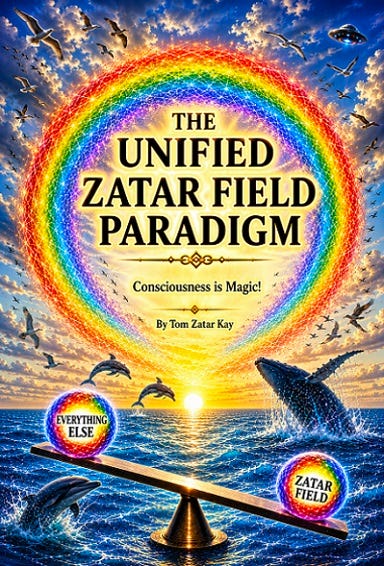
Copyright: 2026 Tom Zatar Kay